


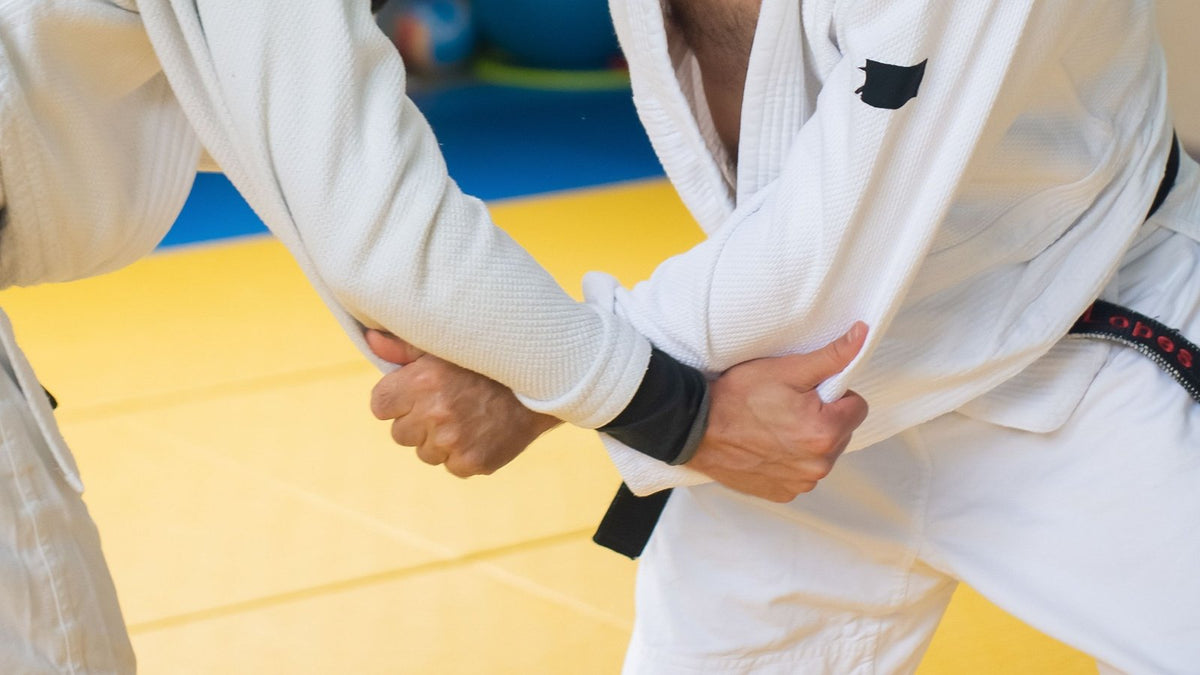
Your guard is technically clean, but you keep losing grip fights: your hands give out before your opponent's do. You are not being outweighed or out-positioned. You are being outlasted. That is a grip endurance problem, and it is fixable.
This guide is for grapplers who have hit the grip plateau. Most BJJ players develop a serviceable grip through rolling, then stall. The adaptations mat time produces have a ceiling, and dedicated training is what breaks through it. Here you will find the four BJJ grip patterns, the difference between Gi and No-Gi demands, five targeted exercises, a 4-week grip block to run alongside your schedule, and a section on common injuries. For the broader framework, the Grip Training for Sports hub is the right starting point.
Why Train Grip Specifically for BJJ
Mat time builds grip. That part is true. Every guard pull, every kimura attempt and every hour of rolling taxes the finger flexors and forearm muscles in ways that produce real adaptation. Beginners improve fast: a few months of regular rolling and grip endurance goes up noticeably without any supplemental work at all.
Then it stalls. The plateau often arrives somewhere between six and twelve months in and does not budge no matter how much you roll. The reason is that BJJ grip demands are repetitive but not progressive. You are holding roughly the same loads, at the same intensities, for the same durations every session. The body adapts to that stimulus and stops, because the stimulus stops changing.
External grip training introduces progressive overload: incrementally harder hangs, heavier kettlebells, grippers that resist more than your training partner's sleeve. In an 8-week study, intermittent dead hangs were effective for improving grip strength and grip strength endurance by 45%. For more background on finger strength training, see the finger strength research inventory at Beta Angel. For programming principles that carry over from BJJ to other pulling sports, see the Grip Training Encyclopedia.
The 4 Grip Types in BJJ
BJJ is not a single grip sport. It is four different grip patterns used in rotation, often within the same exchange. Understanding which grip you are using, and when it tends to fail, tells you exactly what to train. For a deeper read on the science behind BJJ grip work, see The Science of BJJ Grip Strength Training at BJJ Strength.
Collar and Sleeve Grip
One hand on the lapel collar, one hand on the sleeve: the most common closed guard control grip in Gi BJJ. The collar hand needs crushing strength and thumb opposition; the sleeve hand needs sustained closing force against active resistance.
Programming application: Timed holds at the end of Gi pull-up sets, and gripper closes held for 3–5 seconds rather than slammed shut. You need this grip in round 4, not just round 1, so train the endurance, not just the force.
Hook Grip
In BJJ guard play, four fingers hook over the cuff of the sleeve with the thumb curling under for security. It is a deep, fabric-specific catch that traps the sleeve and limits your opponent's elbow freedom, and it is different from the powerlifting hook grip.
Programming application: Gi pull-ups with fabric looped over the bar are the closest gym analog. Towel pull-up variations simulate sleeve fabric and train the finger flexors in a partially open position, which is much closer to actual mat demand than standard gripper work.
Pistol Grip
The fingers and thumb wrap around the outside of the sleeve, the way you would grip a pistol. It is used for guard passing, single-leg takedowns and sleeve-based guard games. Load concentrates on the first two fingers and the thumb.
Programming application: Dead hangs and hangboard work build the underlying finger flexor strength. Kettlebell Viking holds with the bell inverted challenge thumb and lateral finger stability, the same stability that keeps the pistol grip locked under resistance.
Two-Handed Grip
Both hands on one limb. It is used to defend leg attacks, control an arm or break a sleeve grip. This pattern shifts demand from individual finger strength to bilateral coordination and total endurance, with both hands fatiguing at the same time.
Programming application: Dead hang variations that emphasize time under tension rather than peak force. Both hands should fatigue together; if one gives first, that is information. Pair with gripper holds to develop the closing force that breaks a two-handed control attempt.
No-Gi vs Gi Grip Demands
Gi and No-Gi BJJ look related, but from a grip training perspective they are almost different sports. Understanding the difference helps you train what your actual mat time requires.
Gi Grip Demands
In Gi BJJ, you are gripping thick cotton that bunches and shifts under load. The demands are finger-flexor dominant: deep finger flexion to cinch the fabric, and sustained crushing force to survive grip breaks. Finger joint stress accumulates fast, which is why finger joint capsulitis and lumbrical injuries come up so often among Gi players. The training that most closely mimics Gi grip demands: a Gi or towel wrapped around a pull-up bar, hand grippers used for sustained holds, and hangboard edges held with three or four fingers.
For exercises that directly overlap with Gi finger flexor demands, the rock climbing grip training guide covers finger flexor loading in depth. Climbers and Gi players share more training overlap than either group usually acknowledges.
No-Gi Grip Demands
Without fabric to hold, No-Gi grappling shifts to wrist control, body positioning, overhooks and clinch work. There is far less emphasis on isolated finger strength and far more on forearm pronation and supination, wrist flexion and extension, and upper-limb pressure rather than fingertip control. Hand grippers become less sport-specific; wrist roller work and rotational forearm loading take priority.
If you primarily train No-Gi, skew supplemental work toward wrist stability and neutral-grip supporting strength rather than the fabric-specific crushing demands of Gi training. A wrist roller such as the Wrist Wrench covers the wrist roller work, and the wrist trainer collection has the rest of the tools for that end of the spectrum.
The 5 Grip Exercises for BJJ
These five exercises address the grip patterns BJJ demands, run at low volume alongside mat training, and work in any gym or home setup. Programming details are built into the 4-week block below.
Dead Hangs
The foundational BJJ grip exercise: hang from a pull-up bar with an overhand, shoulder-width grip for 20–30 seconds per set, 3–5 sets. Dead hangs train supporting grip endurance, the quality that fails first in long rounds, and intermittent dead hangs are the method behind the 45% result in the 8-week study above. To make the hang harder, thicken the bar with Fat Gripz. For more on dead hang progressions in a pulling context, see how to improve pull-up grip strength.
Rest 60–90 seconds between sets. Stop when grip quality starts to degrade, with the fingers beginning to open slightly, rather than grinding to absolute failure each set. The tendons adapt more slowly than the muscle around them, and chasing failure is how you end up with sore fingers.
Hang Board Pull-Ups
A step up from dead hangs: pull-ups on a hangboard or standard bar, 3–5 challenging reps per set, or 30-second hangs between reps. The combination of hold and pull makes this closer to grappling than either movement alone. A towel over a bar works fine and adds the fabric element that transfers to Gi. Hangboard options are in the climbing hangboard collection, and more on hangboard protocols is in the rock climbing grip training guide.
Gi Pull-Ups
Wrap a Gi or thick towel around the pull-up bar and do pull-ups or dead hangs from that grip. Gi fabric forces your fingers into the patterns you use rolling, and nothing else in the gym does that. Do three to five sets of reps or 20–30 second hangs. See the pull-up grip strength article for progressions.
Kettlebell Viking Holds
Hold a kettlebell by the horns with the bell facing up. Use a kettlebell, not a dumbbell: the inverted bell's off-center weight challenges the wrist extensors and the thumb in the lateral stability pattern that shows up constantly in sleeve and collar control. Start light and hold for 20–30 seconds per set, 3 sets. For other ways to load the hand, browse the grip tools collection.
Hand Grippers
Convenient, portable and underrated for BJJ when used correctly. The common mistake is training for rapid reps. For grappling, train sustained crushing: 3–5 second holds per close, 10–15 rep sets. Use two fixed grippers: a working gripper you can close for every rep of those sets, and a goal gripper one step up that you can barely close or cannot close yet. Heavy Grips come in 2-packs, 3-packs and a 6-pack, so the working and goal grippers arrive together, and Captains of Crush grippers are the long-standing benchmark if you want to test yourself against a known standard. The full range is in the hand gripper collection, and the Complete Guide to Grip Training Equipment covers gripper selection by training level.
4-Week BJJ Grip Training Block
This block runs 2 sessions per week. It is intentionally low volume: your hands are already being taxed by 3–5 mat sessions per week, and adding too much supplemental work is the most reliable way to end up with finger injuries. The goal is enough progressive overload to break the plateau without stacking fatigue on top of fatigue. Run this block on non-rolling days, or at least 6 hours after a mat session.
| Week | Day | Exercise | Sets | Reps / Time | RPE |
|---|---|---|---|---|---|
| 1 | A | Dead Hangs | 3 | 20 sec | 6 |
| 1 | A | Hand Grippers (sustained close) | 3 | 10 reps × 3s hold | 6 |
| 1 | B | Gi Pull-Ups or Towel Hangs | 3 | 20 sec hang | 6 |
| 1 | B | KB Viking Hold | 3 | 20 sec | 6 |
| 2 | A | Dead Hangs | 3 | 25 sec | 7 |
| 2 | A | Hand Grippers (sustained close) | 3 | 12 reps × 3s hold | 7 |
| 2 | B | Gi Pull-Ups or Towel Hangs | 3 | 25 sec hang | 7 |
| 2 | B | KB Viking Hold | 3 | 25 sec | 7 |
| 3 | A | Dead Hangs | 4 | 25 sec | 7–8 |
| 3 | A | Hang Board Pull-Ups | 3 | 4–5 reps | 7 |
| 3 | B | Gi Pull-Ups (full reps) | 3 | 4–5 reps | 7 |
| 3 | B | KB Viking Hold | 4 | 25 sec | 7–8 |
| 4 | A | Dead Hangs | 4 | 30 sec | 8 |
| 4 | A | Hang Board Pull-Ups | 3 | 5–6 reps | 8 |
| 4 | B | Gi Pull-Ups (full reps) | 4 | 5–6 reps | 8 |
| 4 | B | KB Viking Hold + Hand Grippers | 3 each | 30 sec / 15 reps | 8 |
After completing the block, take one week of reduced volume (cut sets in half, keep the intensity) before repeating at slightly higher loads or longer hold times. The hand gripper collection and the grip tools collection have the equipment the block calls for.
Programming Around Mat Days
The most common reason BJJ players develop nagging hand and finger problems from supplemental grip work is not the exercises. It is stacking grip training on top of already-loaded mat days without accounting for recovery.
Many BJJ players train 3–5 mat sessions per week. Each session puts real stress on the finger flexor tendons, the finger pulleys and the wrist ligaments. The tendons do not distinguish between mat load and gym load; they accumulate it regardless of source.
The practical rule: run supplemental grip work on your lightest mat day or on a completely off day. If you train BJJ Monday, Wednesday, Friday and Saturday, then Tuesday and Thursday are your grip days. If it must fall on a mat day, do it after rolling, never before, and keep volume at the lower end of the prescribed ranges. For more on weekly frequency, see How Often Should You Train Grip Strength?
For recovery-integrated programming context across sports, see the Grip Training for Sports hub.
Grip Endurance vs Grip Strength for BJJ
Arm wrestlers need peak grip force. Powerlifters need a few seconds of maximal isometric hold. BJJ players need neither of those as their primary quality. They need grip endurance across 5–10 minute rounds with minimal rest between exchanges.
Peak grip strength matters up to a point. A stronger crush helps you secure the initial grip and resist the first break. But most grip fights are decided by who has grip quality left in minute 7, which is a fatigue resistance question, not a peak force question.
Training emphasis should tilt toward duration rather than maximum load. A 45-second dead hang at moderate effort is more specific to BJJ than a 5-second hang at maximum. Multiple sets of sustained gripper closes (3–5 seconds per close, 10–15 reps) beat single maximal closes. The 4-week block is built on this principle: RPE targets stay moderate (6–8), and hold times increase progressively rather than load.
Still, do not abandon strength work. Peak force raises the ceiling that endurance operates under. Use hangboard pull-ups and heavier kettlebell holds to raise the ceiling; use dead hangs and sustained gripper work to extend the floor.
Common BJJ Grip Injuries
Knowing what goes wrong, and why, helps you catch problems early and train around them rather than ignoring them until they become serious. None of this replaces an assessment by a doctor or physical therapist when something is swollen, unstable or not improving.
Finger Joint Capsulitis
One of the most common BJJ finger complaints. The PIP joint capsule (the middle knuckle) becomes inflamed from repeated strain during grip exchanges: the finger swells, bends poorly and aches after training. Mild cases often settle with reduced volume and buddy taping. If a joint is swollen and painful, reduce Gi grip volume before it becomes a chronic problem.
Lumbrical Injuries
The lumbricals are small muscles in the palm that attach to the finger flexor tendons. Strains and tears most often involve the ring and little fingers and tend to happen when the fingers are in a mixed position under sudden load, which is exactly what happens when a grip break goes wrong. The result is sharp pain in the palm and reduced strength. These are slow to heal. Drop crushing volume and use isometric holds at manageable loads rather than stopping entirely.
Thumb Sprains
Thumb UCL sprains happen when the thumb is caught in a grip and forced away from the hand under resistance, which is common during guard passing. Mild sprains respond to rest and taping. More severe sprains need imaging to rule out a complete UCL tear. Do not train through thumb pain that comes with joint instability.
Frequently Asked Questions
How often should I train grip alongside BJJ?
Two sessions per week is the right ceiling for most BJJ players training 3–5 mat sessions per week. More than that risks stacking tendon stress on top of what rolling already generates. Place sessions on non-mat days or at least 6 hours after rolling. Consistency at 2x/week for 8–12 weeks beats 4x/week for four weeks followed by sore hands.
Will grip work hurt my mat performance from fatigue?
Only if you schedule it wrong. Grip work done before rolling leaves your hands pre-fatigued and increases injury risk. Done on off days or after rolling, with managed volume, it should not affect mat performance, and within a few weeks you should notice grip endurance improving in rounds. Scheduling matters more than exercise selection.
No-Gi vs Gi: does grip training matter as much in No-Gi?
Yes, but the emphasis shifts. Gi demands fabric-specific finger flexor strength. No-Gi demands wrist control and forearm rotation strength. Dead hangs and grippers are still useful, but wrist roller work becomes more central. If you primarily train No-Gi, include wrist stability work from the wrist trainer collection.
Are hand grippers worth it for BJJ?
Yes, with the right usage pattern. The error is chasing rapid reps. For BJJ, use sustained closes: 3–5 seconds per close, 10–15 reps per set, on a working gripper that challenges you in the final reps, with a goal gripper one step up to test against. That trains the strength-endurance quality grip fights demand. Grippers are also the most portable grip tool available. Heavy Grips 2-packs and 3-packs are an easy way to get a working and a goal gripper together.
What is the best single grip exercise for BJJ?
Dead hangs. They are simple, need minimal equipment, train supporting grip endurance directly, and are the basis of the 8-week study showing a 45% improvement. Start at 20–30 seconds per set, 3–5 sets, twice per week. Everything else on this list adds specificity on top of that foundation, but the dead hang alone breaks many grip plateaus if done consistently.
When will I see results?
Grip quality in rounds usually changes within the first few weeks, before strength numbers do, as your nervous system gets better at the task. Measurable endurance improvements typically show at 4–6 weeks, and tendons and connective tissue keep adapting over 8–12 weeks and beyond. Run the 4-week block, take a short deload and repeat.
How do I keep training around finger injuries?
Work around the injured structure, not through it. Capsulitis and lumbrical injuries call for avoiding the specific pattern that aggravates them, not necessarily complete rest. Dead hangs often tolerate better than full crushing. Grippers can continue at reduced resistance with buddy taping. Gi pull-ups are usually the first to go; kettlebell Viking holds and dead hangs often continue. General tendon ache is manageable; sharp joint pain is not, and it is a reason to get the finger checked. The Grip Training for Sports hub has more context across grappling sports.
0 comments