


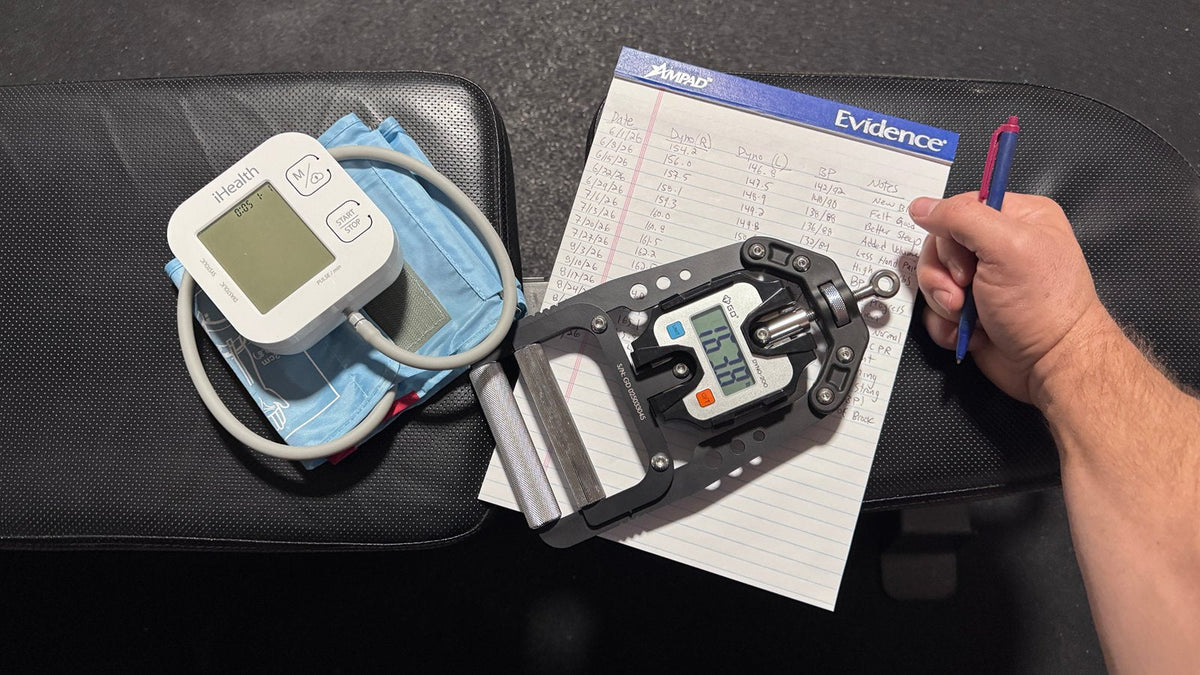
Your bathroom scale tells you how much you weigh. It tells you very little about how well your body is working. A grip reading, taken the same way every month, adds something the scale cannot: a quick look at your muscle, and through it, several systems that depend on muscle.
Over the past two decades, studies of hundreds of thousands of adults have linked grip strength with cardiovascular health, blood sugar control, cognitive function, bone health and frailty. This article explains those links in plain terms and shows you how to use grip as a personal health number, tracked over time next to weight, resting heart rate and blood pressure.
It is the companion to Grip Strength for Longevity and Healthy Aging, which covers the long-term survival research. That article asks "how long will I live?" This one asks "what is happening in my body now?" For the whole topic in one place, start at the Grip Strength Science, Research & Health Hub. When you are ready to train grip, not just measure it, the Rehab & Longevity collection has light tools to start with, like the Heavy Grips Therapy Series.
This article is general education, not medical advice. A grip reading cannot diagnose anything on its own. If your numbers or symptoms worry you, talk to your doctor.
Why Clinicians Pay Attention to Grip
The turning point was the PURE study, published in The Lancet in 2015. It measured grip strength in 139,691 adults across 17 countries and found that grip predicted death from any cause and from cardiovascular disease more strongly than systolic blood pressure, the number most health screening is built around.
In 2019 physical therapist and researcher Richard W. Bohannon reviewed the evidence and argued that grip strength should be measured routinely in older adults. The same year, the European Working Group on Sarcopenia in Older People (EWGSOP2) made low grip strength the first step in diagnosing sarcopenia. Grip testing now appears in frailty screening and in some pre-surgery assessments, and some researchers have called it a new vital sign.
The reason it works is biology, not magic. The muscles that close your hand are skeletal muscle like any other, so grip reflects the strength and quality of your muscle overall. Muscle is where much of your blood sugar is used, it depends on your heart and blood vessels, and it is run by your nervous system. One squeeze carries information from all of them.
Grip and Cardiovascular Health
This is the most studied link. In PURE, each 5 kg lower grip strength went with about a 17% higher risk of cardiovascular death and a higher risk of heart attack and stroke, after adjusting for age, activity, smoking and other factors. In other words, grip carried information beyond simply "this person exercises."
Blood pressure and heart rate are snapshots that can swing from one reading to the next. Grip changes more slowly and reflects your physical condition over a longer window. The two kinds of measurement complement each other; neither replaces the other.
Grip and Metabolic Health
Skeletal muscle is where most of the sugar cleared from your blood after a meal ends up, especially under the action of insulin. When muscle is strong and healthy, that system works well. When muscle quality falls, blood sugar control tends to get harder.
Population studies consistently link low grip strength with insulin resistance and type 2 diabetes, and several find the link holds after accounting for body weight. A grip that is dropping faster than you would expect for your age is not a diagnosis, but it is a reasonable prompt to ask about a fasting glucose or HbA1c test at your next checkup and to look at whether you are doing enough resistance training.
Grip and Cognitive Function
The brain connection surprises most people. Large studies, including the UK Biobank, have found that stronger grip goes along with better performance on cognitive tests, and long-term studies link lower grip strength with a higher risk of cognitive decline and dementia in older adults.
Researchers think shared factors explain much of this: blood vessel health, inflammation and physical activity affect both muscle and brain. It is an association, not proof that grip training protects memory, but a steady decline in grip in someone over 55 deserves the same attention as a change in blood pressure.
Grip, Sarcopenia and Frailty
Sarcopenia is the gradual loss of muscle strength and mass with age. It speeds up in later life and is tied to falls, hospital stays, slower recovery from illness and loss of independence. It is a clinical diagnosis, and grip strength is the first screen.
Under EWGSOP2, grip below 27 kg for men or below 16 kg for women counts as low strength, and the assessment continues with muscle mass and physical performance tests. The Fried frailty phenotype, a widely used frailty screen, also includes weak grip as one of its five criteria.
The practical point is not to wait for a diagnosis. Testing monthly from your 40s onward gives you a trend line. If it heads steadily down, the main levers are resistance training, enough protein and good sleep. For programming around injuries, see The Role of Grip Strength in Injury Prevention and Rehabilitation; for joint-friendly training, see Arthritis-Safe Grip Programs for Adults 50+.
Grip and Bone Health
Muscle pulling on bone is one of the main signals that keeps bone strong. Studies generally find that people with stronger grip have higher bone mineral density, including at the wrist and hip, which are among the most common sites of serious fractures, and that low grip is more common in people with osteoporosis.
Grip tracking does not replace a bone density (DXA) scan. It is an easy early signal: if your grip is falling and nothing in your routine explains it, mention it to your doctor along with any other changes.
Summary Table: What Grip Can Tell You
| Health area | What grip reflects | How strong the evidence is |
|---|---|---|
| Cardiovascular health | Overall muscle strength and quality; linked with cardiovascular death, heart attack and stroke risk | Strong: PURE (139,691 adults, 17 countries) and other large cohorts |
| Metabolic health | Muscle's role in blood sugar control; linked with insulin resistance and type 2 diabetes | Strong: consistent across population studies |
| Cognitive function | Shared vascular and lifestyle factors; linked with cognitive test scores and dementia risk | Moderate: large studies show an association, not cause |
| Sarcopenia and frailty | First screening step for low muscle strength | Very strong: built into EWGSOP2 and frailty screens |
| Bone health | Muscle loading on bone; linked with bone density at the wrist and hip | Moderate: consistent association in multiple studies |
How to Use Grip as a Personal Health Number
One reading on its own tells you roughly where you stand and nothing about direction. The value is in the trend.
Think of it like your weight. A single weigh-in is just a number; six months of weigh-ins show whether you are gaining, losing or holding steady. Grip works the same way. A reading every month builds a trend line. Several months heading down is meaningful; a small wobble from one month to the next is noise.
Read grip alongside the numbers you already track. Weight up and grip down over the same three months tells a different story from weight steady and grip falling on its own. Grip adds the one thing the others miss: how your muscle is doing.
For the test itself you need a hand dynamometer. Basic digital models are inexpensive, and using the same device the same way every time matters more than which model you choose. A hand gripper is a training tool, not a measuring tool, so it cannot stand in for a dynamometer here (more on that in the FAQ).
Grip Tracking Protocol
| Element | Recommendation | Why it matters |
|---|---|---|
| How often | Once a month, same day of the month | Long enough to see real change; testing more often mostly captures day-to-day swings |
| Tool | The same hand dynamometer every time | Different devices read differently |
| Position | Seated, upper arm against your side, elbow at about 90 degrees, wrist neutral | The standard research position; keeps readings comparable |
| Trials | 3 squeezes per hand, about 60 seconds rest between | Best of three smooths out a bad attempt; rest prevents fatigue |
| Timing | Same time of day, after a light hand warm-up, before any training | Fatigue from training lowers readings |
| What to record | Best reading for each hand, the date and the time | Tracking both hands catches one side falling behind |
| Track alongside | Body weight, resting heart rate and blood pressure if you have a monitor | Context makes any change easier to interpret |
When to Act on a Falling Trend
One low reading is not a problem. Grip moves with sleep, hydration, stress and training fatigue. Three or more monthly readings heading steadily down, with no obvious reason such as an injury or a planned break, is what deserves attention.
Start with the usual suspects: training, protein and sleep. Those explain most short-term drops and you can fix them yourself. Give changes one to two months and see whether the trend turns around.
See your doctor sooner if the drop is large, if it keeps going after you have addressed those basics, if one hand is falling while the other holds steady, or if it comes with numbness, tingling or other new symptoms. Bring your log; a dated record of readings is far more useful to a clinician than "I feel weaker."
The encouraging part: grip responds to training at any age. If you want to move from tracking to training, the health hub has a simple three-day template, and the Rehab & Longevity collection has light tools for it, including the Heavy Grips Therapy Series and Fitness Series grippers and the IronMind Expand-Your-Hand Bands for finger extension.
Frequently Asked Questions
What is a normal grip strength?
It depends on age, sex, body size and the device. Grip usually peaks in your 30s and declines slowly after that, faster later in life. The longevity article has a table of typical ranges by age and gender. As a clinical reference point, EWGSOP2 treats grip below 27 kg in men and 16 kg in women as low.
My grip dropped over three months. Should I worry?
Check the basics first: training, protein, sleep and stress. If the drop continues after you have addressed those, or it is large, one-sided or comes with other symptoms, take your log to your doctor. A decline with no clear cause is worth looking into, but it is a signal to follow up, not a reason to panic.
What dynamometer should I use at home?
Clinics often use hydraulic dynamometers such as the Jamar. For home tracking, a basic digital dynamometer is fine as long as you use the same one, in the same position, every time. Consistency matters more than absolute precision when you are tracking a trend.
Should I track grip or weight?
Both. Weight tells you about mass; grip tells you something about how well your muscle works. Most people track weight and never measure grip. Adding one grip test a month costs a minute and fills in a big part of the picture.
Can I use a hand gripper to track grip strength?
Not as a measurement. A gripper's rating tells you the resistance you closed, not the force you produced, and closing a gripper also depends on technique and hand size. A dynamometer gives a number you can compare month to month and with research values. Grippers are the right tool for building grip; see the Hand Grippers collection and how to choose a starting resistance.
Why does grip predict cardiovascular health?
The leading explanation is that grip reflects overall muscle strength and quality, which are tied to blood sugar control, inflammation and blood vessel health. The link held in PURE after adjusting for physical activity, so it is not just a sign that someone exercises.
Does grip come back when health improves?
Yes. Resistance training raises grip directly, and improvements in overall health help too. For a realistic timeline, see How Long Does It Take to Improve Grip Strength?, and for the tools, The Complete Guide to Grip Training Equipment.
References:
Leong DP, Teo KK, Rangarajan S, et al. Prognostic value of grip strength: findings from the Prospective Urban Rural Epidemiology (PURE) study. Lancet. 2015;386(9990):266-273.
Bohannon RW. Grip Strength: An Indispensable Biomarker For Older Adults. Clin Interv Aging. 2019;14:1681-1691.
Cruz-Jentoft AJ, Bahat G, Bauer J, et al. Sarcopenia: revised European consensus on definition and diagnosis. Age Ageing. 2019;48(1):16-31.
0 comments