


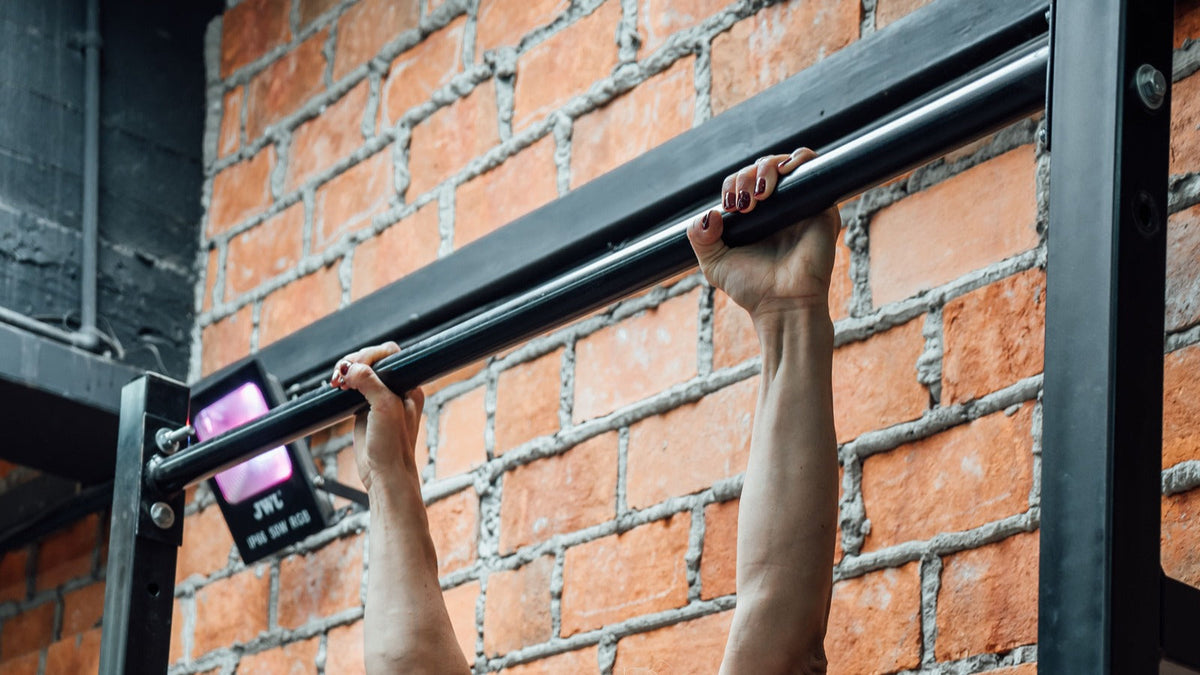
In CrossFit, your grip rarely fails because it is weak. It fails because nothing else fails first. You can press, squat and row through most of a metcon without hitting a muscular wall, but put toes-to-bar, kipping pull-ups, kettlebell swings and barbell cycling in the same workout and your hands are usually the first thing to quit.
This article is for CrossFit athletes whose grip is cutting WODs short, causing palm tears, or forcing broken sets in benchmark workouts. The fix is not just "make grip stronger". It is building grip that lasts through high-volume, mixed-modal work, survives chalk, sweat and kipping friction, and recovers fast enough to train the next day. For the full sport-by-sport framework, start with the Grip Training for Sports hub. For the fundamentals, see the Grip Training Encyclopedia.
The CrossFit Grip Demand Pattern
CrossFit grip is different from powerlifting, strongman or climbing. Peak loads are not higher; the demand is relentless, mixed, and layered on top of metabolic fatigue. A 1RM deadlift challenges grip for a few seconds. A 21-15-9 of toes-to-bar and thrusters challenges it for minutes, across several movement patterns, while your heart rate is already climbing.
The kipping pull-up, toes-to-bar and kettlebell swing combination is the clearest example. Each movement loads the hand differently:
- Kipping pull-ups use a dynamic supporting grip, with the bar shifting slightly in the palm during the kip swing. That back-and-forth friction across the skin is what creates tears. The skin is working as hard as the muscles.
- Toes-to-bar need a full hanging grip through the swing, then a sharp hip flexion that sends whole-body tension through the hands. At typical WOD volumes, total time under tension runs into minutes.
- Kettlebell swings shift the load to the fingers as the handle swings through the hip hinge. High-rep kettlebell work creates different friction and pressure than bar work, and that fatigue stacks on top of the bar fatigue you already have.
By the second or third movement in a triplet, your grip is already tired when the next demand arrives. That is not a raw strength problem. An athlete who can dead hang for 90 seconds fresh might fail at 20 toes-to-bar because their hands have been under load for six minutes. Training for this means building grip endurance under accumulated fatigue, not just peak strength.
For how strict and kipping pull-ups load the grip differently, see How to Improve Pull-Up Grip Strength.
Tear Prevention: Calluses, Chalk and Gymnastics Grips
Tears are the most disruptive grip problem in CrossFit, not because they hurt, but because they sideline you. A bad palm tear can keep you off the bar for several days. Most tears are preventable.
Callus Management
Thick, stacked calluses cause more tears than they prevent. A raised callus ridge catches on the bar during kipping, pinches between bar and skin, and tears, often taking healthy skin with it. The fix sounds backwards: keep calluses filed down to a smooth, flat surface instead of letting them build up.
After a shower, use a pumice stone or callus file on the pads below your fingers and the heel of the palm. You are not removing the callus, only keeping it level with the skin around it so there is no ridge to catch. Once or twice a week during high-volume blocks is enough. Athletes who file consistently tear far less often. Those who skip it and add more chalk are solving the wrong problem.
Also moisturize at night. Dry, cracked skin tears more easily. Plain hand lotion before bed (not before training) keeps the skin from getting brittle.
Chalk
The most common chalk mistake is caking it onto wet palms. That makes a paste that builds up across sets and increases abrasive friction, which speeds up tears.
Aim for a light, dry coat: enough to absorb sweat, not so much that it leaves white residue on the bar. Re-chalk between sets in small amounts. Many athletes in humid boxes use liquid chalk as a thin base layer and touch up with powder. For powdered chalk, Metolius Super Chalk is our pick for bar work, and the rest of our chalk is in the chalk and accessories collection.
Gymnastics Grips
Gymnastics grips reduce bar friction and protect the skin on pull-ups, toes-to-bar and muscle-ups. They are a legitimate tool, and it is worth being clear about when they help.
When grips help: high-rep bar cycling when friction is the main tear risk, coming back from a fresh tear, and competition, when a mid-WOD tear costs more than any training benefit.
When grips hurt: worn every session, they stop your skin from toughening and you come to depend on them. They also change how the bar feels, which affects kipping technique. Train without them regularly so your hands adapt to the bare bar.
Use grips for your highest-volume sessions and competition. If you wear them every session and still tear, the callus and chalk routine above is what needs fixing.
Grip Endurance vs. Raw Grip Strength
Most CrossFit athletes who add grip training make the same mistake: they train peak strength when they need endurance. In a metcon, the maximum force your hand can produce matters less than how long you can keep a working grip before your forearms pump out. What limits your toes-to-bar sets is almost never peak strength. It is local muscular endurance in the forearm muscles that close the hand.
Raw strength still matters for heavy barbell cycling: near-maximal cleans, snatches and thrusters need enough grip to hold a hook or full grip through an explosive lift. For deadlift-heavy WODs, our deadlift and powerlifting grip guide covers hook grip and heavy holds in full.
A practical rule: spend about 70% of your grip training on endurance work (dead hangs, farmer's carries, wrist roller) and about 30% on strength work. If you are following Open-style programming, lean even further toward endurance.
The 4 Essential Grip Exercises for CrossFit Athletes
Dead Hangs (High Volume)
Dead hangs train the exact grip of pull-ups and toes-to-bar: an overhand bar grip under bodyweight. Do 3 to 4 sets of 45 to 90 seconds, resting 60 to 90 seconds. The goal is total time under tension, not one max hang. Shifting your weight gently from hand to hand during the hang mimics the moving load of kipping better than a still hold. For a harder variation, hang from a pair of Monkee Grip Rope Grips looped over the bar.
Farmer's Carries
Farmer's carries build the supporting grip endurance that carries over to everything heavy in CrossFit. Use heavy dumbbells, kettlebells or a trap bar. Experienced athletes can work up to about half their bodyweight per hand; start lighter. Do 2 to 3 sets of 40 to 60 meters, resting 90 seconds. To make the handles thicker and the grip harder, wrap them with Fat Gripz.
Wrist Roller (Endurance)
The wrist roller builds the forearm's ability to keep working while it burns. Do 2 sets of full rolls (all the way up and all the way down is one set) at a moderate load, around 7 to 8 out of 10 effort. Start with a 5 or 10 lb plate: wrist roller work gets hard fast. This is forearm conditioning, not max strength work. Our pick is the Wrist Wrench, and more options are in the wrist trainers collection.
Reverse Curls and Extensor Work (Balance for Elbow Health)
Reverse curls (a barbell or dumbbell curl with an overhand grip) train the muscles on the back of the forearm and counterbalance all the closing-the-hand work of CrossFit bar training. Over time, an imbalance between the muscles that close the hand and the ones that open it can contribute to outer-elbow pain and forearm tightness. Do 3 sets of 12 to 15 reverse curls at the end of a session, twice a week, light enough that your form holds. This is prehab, not performance. Add 2 sets of 20 finger extensions with IronMind Expand-Your-Hand Bands to train the hand-opening muscles directly. Do not skip either because it feels easy.
4-Week Grip Endurance Block
This block runs alongside your regular CrossFit programming. Day 1 is pre-WOD (brief, not tiring). Day 2 goes on an off day and is your main grip session. Do not do Day 2 work the day before a heavy barbell WOD or a high-volume bar day. Effort is on a 1 to 10 scale, where 10 is all you have.
| Week | Day 1 (Pre-WOD, 8–10 min) | Day 2 (Off Day, 20–25 min) | Volume | Effort |
|---|---|---|---|---|
| 1 | Dead hang 3 × 30 sec, rest 60 sec | Farmer's carry 3 × 40 m; wrist roller 2 × 1 full roll; reverse curl 3 × 12 | Low to moderate | 6–7 |
| 2 | Dead hang 3 × 40 sec, rest 60 sec | Farmer's carry 3 × 50 m; wrist roller 2 × 1.5 full rolls; reverse curl 3 × 12 | Moderate | 7 |
| 3 | Dead hang 4 × 45 sec, rest 60 sec, shifting weight between hands | Farmer's carry 4 × 50 m; wrist roller 3 × 1.5 full rolls; reverse curl 3 × 15 | Moderate to high | 7–8 |
| 4 (Deload) | Dead hang 2 × 30 sec, rest 90 sec | Farmer's carry 2 × 40 m at 20% less weight; wrist roller 2 × 1 full roll; reverse curl 2 × 10 | Low | 5–6 |
Finish every Day 2 session with 2 sets of 20 band finger extensions. After the block, retest your max dead hang and how many bar reps you hold unbroken in WODs. Most athletes notice a real difference within the first two cycles. Repeat the block with about 5 to 10% more weight on the carries and 5 to 10 more seconds per hang set.
For help choosing tools to support this block, see The Complete Guide to Grip Training Equipment.
Programming Around MetCon Days
When you do grip training matters as much as what you do. Put it in the wrong place and you go into WODs with tired forearms, which undermines both.
Pre-WOD: keep it short and easy. Prime the hands, do not tire them. If the WOD has heavy bar work or high pull-up or toes-to-bar volume, skip pre-WOD grip work that day.
Post-WOD: generally not recommended. Grip work after a metcon means sloppier form, higher tear risk and slower recovery. Reverse curls and band extensions are the exception; they are easy enough to add at the end of any session.
Off days: your main slot for grip development. The Day 2 sessions in the table are built for these days, so you can train hard without hurting WOD performance.
Competition week: drop all grip accessory work four to five days out. Your hands need to be fresh.
WOD-Killer Grip Work: Toes-to-Bar, Fran, Murph
Some benchmark WODs expose grip weaknesses more than others. Here is what targets each one.
Toes-to-Bar
In high-rep toes-to-bar, the grip fails on skin and forearm endurance, not peak strength. Train the kipping pattern directly:
- Kip swings: hang from the bar and practice the kip swing (hips back and forward) for 30 to 45 seconds without bringing your toes up. This trains the exact grip demand, with kipping friction and a moving load, at a lower skill cost and higher volume.
- Active hang holds: a dead hang with the shoulders engaged (pulled slightly down and back), 3 to 4 sets of 45 to 60 seconds. This builds the shoulder and grip endurance toes-to-bar needs across several sets.
Fran (21-15-9 Thrusters and Pull-Ups)
Fran is a forearm pump problem. Barbell cycling and high-rep pull-ups load the grip in two different ways with no recovery in between:
- Barbell regrip practice: load a barbell at your Fran weight and do 5 to 8 reps, drop it, regrip quickly and repeat. This trains how fast you can re-establish a solid grip, not just endurance.
- Hang and carry superset: a 30-second dead hang straight into a 30-second moderate farmer's carry. Repeat 3 to 4 rounds with minimal rest. It mimics the way Fran stacks grip demand from one movement to the next.
Murph (100 Pull-Ups, 200 Push-Ups, 300 Air Squats)
Murph is volume over a long time domain. Your hands go back to the bar dozens of times over 30 to 60 minutes:
- Accumulated hang time: in a Murph training block, build to 10 to 15 minutes of total hang time per week, in short-to-medium sets with little rest rather than single max sets.
- Slow-lowering pull-ups: take 3 to 5 seconds to lower, 5 sets of 5, twice a week in the 4 to 6 weeks before Murph. This builds the forearm and elbow endurance sustained pull-up volume needs, and it is good elbow prehab.
- Callus care is not optional: file your calluses the week before Murph, use the light chalk routine, and do not try a full bare-hand Murph for the first time on Memorial Day.
Frequently Asked Questions
Are gymnastics grips cheating?
No. They are a legal tool, and most competitive CrossFit athletes use them strategically. The question is when, not whether. Wearing grips every session stops your skin and grip from adapting to the bare bar. Wearing them for your highest-volume bar days and competition, while training bare-handed regularly, is the sensible approach. If grips are covering up a real grip endurance gap, that is a programming problem, and grips will not solve it.
How do I prevent tears during high-volume WODs?
Three things together: keep calluses filed smooth (flattened so there is no raised ridge to catch, not removed), use a light dry coat of chalk instead of caking it on, and build bar volume gradually so your skin toughens over time. If you jump from low bar volume to Murph prep overnight, you will tear regardless. Skin adapts to progressive overload the same way muscle does, and you cannot rush it.
What is the best chalk for CrossFit?
Standard magnesium carbonate chalk works for most bar work. A good powder such as Metolius Super Chalk covers the job. For long metcons with several transitions, liquid chalk goes on as a thin dry layer that lasts longer per application and avoids the buildup of over-chalked palms. Some athletes use liquid chalk as a base and powder for touch-ups. Whatever you use, apply less than you think you need.
Do I need grip work if I do CrossFit 5 times a week?
Probably, but not much. Five days of CrossFit gives your grip plenty of volume, mostly endurance at WOD pace. What is missing is progressive overload aimed at the grip itself, balancing work for the muscles that open the hand, and the callus routine that prevents tears. Two 20-minute grip sessions a week plus short pre-WOD dead hangs is enough extra work for most athletes training five days a week. More is not better when you already train that often.
Should I do grip work before or after a WOD?
Light activation work (dead hangs, 3 × 30 seconds) is fine before a WOD. Substantial grip training belongs on off days. If that is not possible, a short post-WOD block (reverse curls, band extensions, wrist roller) is the least disruptive option, but know that your hands are already tired and tear risk is higher. The programming table above is built around this.
Can grip endurance be overtrained?
Yes, and more often than people think. Tendons adapt and recover more slowly than the muscles around them. Athletes who add heavy grip work on top of a five-day CrossFit schedule and wonder why their forearms always feel tight are often doing too much. Warning signs: forearm tightness that does not clear with a day off, elbow discomfort that is worse in the morning, and grip endurance that drops despite consistent training. The fix is a real deload: cut volume by 40 to 50% for a week. That is why Week 4 of the block is a deload.
My calluses keep ripping. What is the fix?
Almost always callus thickness. Thick, raised calluses catch on the bar during kipping and tear the skin around them. File them down after a shower with a pumice stone until they are level with the skin around them, and moisturize at night to keep the skin flexible. If you keep tearing in the same spot, that spot needs more attention. Filing twice a week during high-volume blocks prevents most tears of this kind.
Where to Go from Here
CrossFit grip is a solvable problem. Callus care, smart chalk use, grip endurance training and programming around metcon days take care of most broken sets, palm tears and forearms giving out mid-WOD.
Start with the Grip Training for Sports hub for the full sport-by-sport framework. For barbell-heavy WODs, the deadlift and powerlifting grip guide covers hook grip, bar position and heavy holds. For pull-up grip endurance, kipping versus strict, and dead hang progressions, read the pull-up grip strength guide.
For equipment: the Wrist Wrench and the GripSaver Plus are in the wrist trainers collection; Fat Gripz and other barbell tools are in the lifting and general strength collection; chalk is in the chalk and accessories collection.
The hands that break sets and rip in Week 1 are not the hands you are stuck with. They are just undertrained. Build the endurance, look after the skin, program it sensibly, and your grip stops being the ceiling on your CrossFit performance.
0 comments