


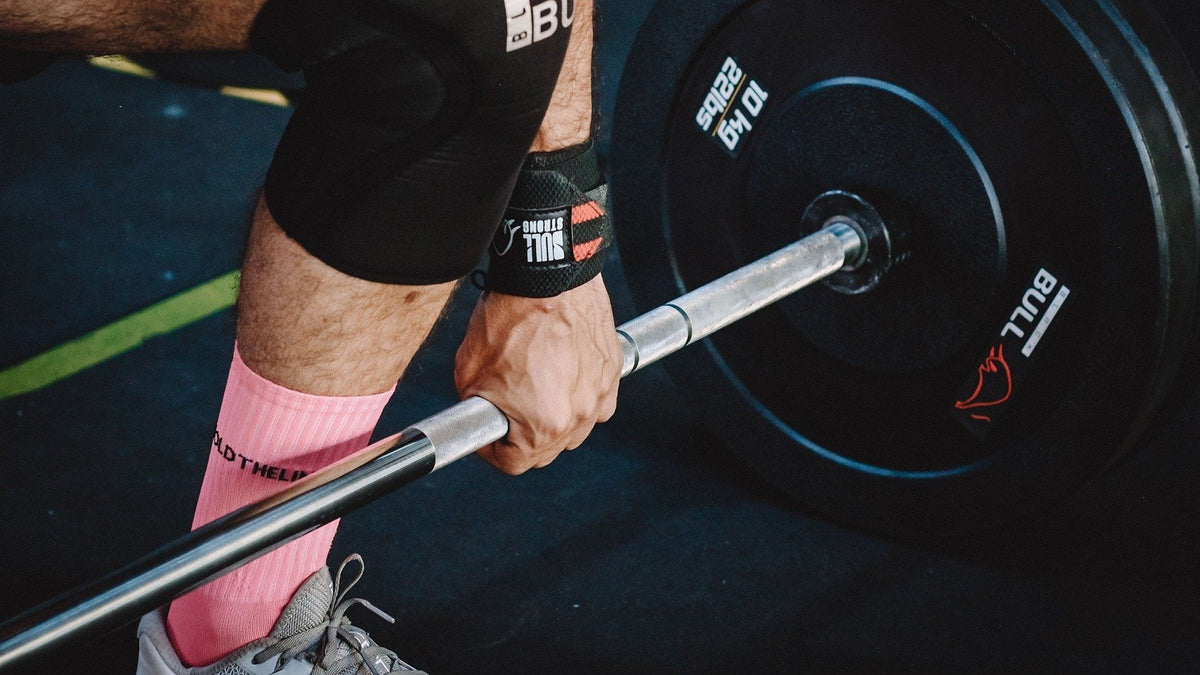
Your deadlift stalled at the grip. The bar is moving, your legs and back have more in the tank, and then the bar starts rolling out of your hands. Not because your back is weak. Not because your legs gave up. Because your fingers opened first.
This article is for intermediate and advanced powerlifters and serious recreational lifters who have already hit the grip ceiling. It covers hook grip technique in depth, gives an honest comparison of hook grip, mixed grip and straps, and includes a 4-week break-in protocol plus programming tables you can drop into your current training. For the wider sport-by-sport picture, start with the Grip Training for Sports hub.
Why Your Deadlift Stalls at the Grip
Many lifters hit their first real grip plateau once their deadlift climbs into the 300s. They assume it is a strength issue and reach for straps. The real pattern is that grip fails before the posterior chain is anywhere close to its limit. The hamstrings, glutes and spinal erectors could pull more. The hands quit first.
The mechanism is supporting grip endurance: the ability to sustain an isometric hold under load without the fingers unwinding. A lifter can close a heavy hand gripper and still have fingers that peel off a bar at 85% of max, because holding a bar is a different job from closing a gripper. A max deadlift asks for a sustained hold through the full range of motion, typically 3 to 6 seconds, under near-maximal tension.
There is also a technical piece most people ignore: where the bar sits in the hand. It should sit low, across the base of the fingers, not deep in the palm. A bar set deep in the palm rolls down toward the fingers as you pull, which loosens the grip at exactly the wrong moment. Fix bar placement before adding any accessory grip work. Chalk is non-negotiable too: it takes sweat out of the friction equation (Metolius Super Chalk is what we stock for lifters, and the rest is in the chalk and accessories collection). If you have been relying on straps to make up for a gym that bans chalk, your supporting grip is almost certainly undertrained.
The practical diagnostic: next session, take your working weight and do one set without straps, chalk only. If your grip breaks before the set feels hard anywhere else, grip is the limiter. That is trainable, and faster than most people expect.
Hook Grip vs. Mixed Grip vs. Straps: An Honest Comparison
Every intermediate lifter eventually faces the grip-style decision. Here is the breakdown across all three, including the risks that tend to get glossed over.
| Grip Style | Pros | Cons | Best For | Risk |
|---|---|---|---|---|
| Hook Grip | Symmetric loading; no rotation through the spine; used by virtually all elite Olympic weightlifters and many top powerlifters | Painful for the first 2 to 4 weeks; needs a deliberate break-in; can feel weaker than mixed grip at first; hard for lifters with very short thumbs | Powerlifters who want a long-term solution; frequent heavy pulling with even loading; sumo deadlifters | Bruising under the thumbnail and thumb joint irritation if loaded too fast; managed with tape and gradual loading |
| Mixed Grip (over-under) | Immediately stronger than double overhand; no break-in; widely coached | Uneven loading of the biceps and shoulders; the underhand arm is supinated under load; a slight twist accumulates with volume | Occasional max efforts; competition when hook grip is not trained; a stopgap while learning hook grip | Biceps tear on the underhand arm, a documented competition injury. The risk is highest at max loads, when fatigued, and when that elbow bends at lockout. |
| Straps | Takes grip out of the equation; allows more posterior chain volume; right for RDLs, rack pulls and shrugs where grip is not the target | Not allowed on the deadlift in powerlifting competition; prevents grip adaptation; hides a grip weakness until a meet exposes it | Accessory volume; hypertrophy-focused pulling; any set where the posterior chain, not the grip, is the target | No direct physical risk. The risk is performance: an undertrained grip shows up at the worst time |
Straps are a legitimate tool for accessory work. The problem is using them for every heavy set, which keeps the grip weakness permanently in place. Mixed grip works, but alternate which arm goes underhand from session to session to spread the uneven load. The biceps tear risk is real at max loads under fatigue.
The tools that support the training below are in the lifting and general strength collection and the grip sport and armlifting collection.
Hook Grip Break-In Protocol: 4 Weeks
Hook grip is the most effective long-term grip strategy for most powerlifters, but weeks 1 and 2 hurt. The thumb is pinned under the fingers, its joints are loaded in an unfamiliar way, and the skin under the thumbnail takes friction it has never had before. That discomfort is your hands adapting, not getting injured, as long as you load it gradually.
Weeks 1 to 2: Soreness Is Normal, Sharp Pain Is Not
Use hook grip for all warm-up sets and for working sets up to 70 to 75% of your max. Normal: thumb soreness that peaks 12 to 24 hours after training, tender skin under the thumbnail, and a feeling that the grip is weaker than double overhand. That is the adaptation phase.
Back off immediately if you get sharp pain in the thumb joint during the lift (not after), numbness that does not clear within 10 minutes, or nail discoloration with increasing pain.
Taping: wrap one or two layers of 1-inch athletic tape around the base segment of the thumb before every session in weeks 1 and 2. Start taping before it hurts, not after. Many elite weightlifters tape their thumbs for their whole careers. It is protection, not a crutch.
Weeks 3 to 4: Building Load Tolerance
By week 3 the acute soreness should be much lower. Extend hook grip to all sets up to 85% of your max. If soreness is still significant in week 3, stay at the 75% ceiling for one more week before going higher. Everyone adapts at a different rate, and rushing it usually sends lifters back to mixed grip out of discomfort.
Practice the lock-up deliberately: thumb flat against the bar, first two fingers pressing firmly over the thumbnail, knuckles driving toward the floor as you start the pull. The thumb is not passive. The overlapping fingers hold it in place for the whole lift.
By week 5, most lifters no longer think about the thumb mid-set. You can taper the tape to heavy sessions only, or keep it permanently. Both work.
Heavy Holds: The Most Direct Grip Builder
Holds are the most direct accessory for deadlift grip, because a heavy pull is a hold: the bar has to stay locked in your hands for the whole rep. The principle is to hold heavier than you pull, and to hold longer than your deadlift set takes. Use two kinds, both as finishers after your main working sets.
Overload Holds on the Barbell
Set the bar in a rack or on blocks just below lockout height, so you are only standing it up an inch or two and holding. Same bar, same grip you compete with, chalk, no straps.
- Set 1: 100% of your top deadlift set weight. Hold for 10 to 20 seconds. Rest 90 seconds.
- Set 2: 110% of your top deadlift set weight. Hold for 10 to 15 seconds. This is the overload set and it should be hard for the full duration. That is the point.
If your top set is 405 lb, holding 445 lb for 12 seconds builds a buffer that makes 405 feel secure in your hands. Progress slowly: add 10 to 15 lb every 3 to 4 weeks. Tendons adapt more slowly than muscle.
Thick-Bar Holds
A thicker handle forces the fingers into a more open position, so they have to work much harder to hold the same weight. That makes the standard bar feel easier by comparison. Wrap a pair of Fat Gripz around the barbell (start with the One or Pro size) and hold for time.
- Load: start around half of your top deadlift set weight. A thick bar cuts how much you can hold, so let the clock, not the plates, set the difficulty.
- Sets: 2 holds of 20 to 30 seconds, 90 seconds rest.
- Progression: when both holds reach 30 seconds, add 10 lb.
For how thick-bar work fits into strongman training, our strongman grip events guide covers axle deadlift programming in depth.
Wrist Roller for Forearm Size and Grip Endurance
The wrist roller is underused in powerlifting prep. It builds forearm size and grip endurance that carries over to volume work: the 5×5 and 4×3 sessions where grip fatigue builds across sets. A lifter with well-developed forearms holds a hook or double overhand grip more reliably on sets 4 and 5 of a volume day. Our pick is the Wrist Wrench, a stainless steel wrist roller with a knurled handle; more options are in the wrist trainers collection.
- Load: start light, with a 5 or 10 lb plate. Wrist roller work gets hard quickly.
- Volume: 3 sets of 3 complete up-and-down rolls.
- Tempo: controlled, about 2 seconds per turn. The forearm pump should be significant by set 3.
- Frequency: 2 sessions per week, on days without heavy deadlifts.
- Progression: add 1.25 to 2.5 lb every 2 weeks once the current load feels manageable across all sets.
Do not do wrist roller work on the same day as heavy deadlifts. The forearm fatigue it creates reduces grip security on your main lifts. For lifters who combine heavy barbell work with gymnastics or conditioning, our CrossFit grip guide covers how to fit endurance work around heavy deadlift days.
Static Hold Finisher
After your heavy holds, run a short static hold finisher with a standard barbell. Total time is under 5 minutes, so it adds grip volume without making the session longer.
- Exercise: barbell deadlift hold, no straps, chalk, double overhand or hook grip
- Load: 60 to 70% of your top set weight
- Hold: 20 to 30 seconds per set
- Sets: 2 to 3, with 60 seconds rest
- Placement: end of the deadlift session, after the heavy holds
The goal is time under tension at a load that keeps your grip technique honest. This finisher is especially useful for lifters who have leaned on mixed grip or straps, because it forces adaptation in the grip style they actually need. For variety on off days, plate holds on a Country Crush Loading Pin train the same supporting grip one hand at a time. For the full range of grip tools and what each one trains, see The Complete Guide to Grip Training Equipment.
Deadlift Grip Integration: Programming Table
This 4-week table assumes a standard powerlifting week with one heavy deadlift day and one or two other days available for grip work. Effort is on a 1 to 10 scale, where 10 is all you have.
| Week | Deadlift Day Finisher | Off-Day Grip Work | Notes and Effort |
|---|---|---|---|
| 1 | Overload holds: 10s at 100%, 10s at 110% of top set; thick-bar holds: 2×20s | Wrist roller: 3×3 rolls, light; extensor work: 2×20 | Hook grip on all deadlift sets above 60%. Effort 7 to 8 on holds. Focus on thumb tape and bar position. |
| 2 | Overload holds: 12s at 100% and 110%; thick-bar holds: 2×25s | Wrist roller: 3×3 rolls; farmer's carry: 2×30s at 40% of bodyweight per hand | Effort 8 on the overload set. Expect thumb soreness to peak and then start to ease this week. |
| 3 | Overload holds: 15s at 100% and 110%; thick-bar holds: 2×30s; static holds: 3×20s at 70% | Wrist roller: 3×3 rolls, slightly heavier; loading pin holds: 2×20s per hand | Hook grip should feel more secure. Effort 8 to 9 on the overload set. Add 10 lb to the thick-bar holds if both reached 30 seconds. |
| 4 | Overload holds: 20s at 100%, 15s at 110%; thick-bar holds: 2×30s; static holds: 3×25s at 70% | Wrist roller: 3×3 rolls; farmer's carry: 2×40s at 45% of bodyweight per hand | Effort 9 on the overload set. Deload next week if you are also running high deadlift volume. Most lifters are through the worst of the break-in by the end of week 4. |
After week 4, reassess. If hook grip feels reliable up to 85 to 90% of your max, run another 4 weeks with small load increases on the holds. If it still feels insecure above 75%, run 2 more break-in weeks before pushing the load higher.
Programming Around Heavy Deadlift Day
The connective tissue in the forearm recovers more slowly than the surrounding muscle, so give your grip a couple of days between hard efforts. Stacking grip work just before your heavy deadlift day loads tired tissue at exactly the moment you need it fresh.
When Not to Do Grip Work
- No wrist roller or heavy farmer's carries the day before your heavy deadlift. Forearm fatigue from even moderate wrist roller work can reduce grip security the next day, and you will not notice it until you are under load.
- No hand gripper work on deadlift day. Grippers tire the same forearm flexors you need for holding. Even a moderate gripper session a couple of hours before heavy pulls can cost you a rep.
- No holds before your main deadlift sets. The finisher always comes after the main work is done.
- Take a deload every 4 weeks. Cut volume by about 40% and keep the weights around 80%. Skipping deloads in grip-heavy blocks is the most common path to wrist and forearm tendon irritation.
Between heavy sessions, light unloaded finger and wrist movement helps recovery. Finger extensor work, opening the hand against resistance for 2 sets of 20, keeps the flexors and extensors in balance and helps head off the outer-elbow irritation that builds up when lifters only ever train closing the hand. Our pick is the IronMind Expand-Your-Hand Bands, or use the GripSaver Plus if you want flexion and extension in one tool. Three minutes at the end of every grip session. Skip it long enough and you will feel it in the elbow.
Frequently Asked Questions
Should beginners learn hook grip?
Yes, with context. If your max is below about 250 lb, double overhand is usually fine, because grip is not yet the limiting factor. Start the hook grip break-in once you are training consistently and pulling somewhere around 200 to 300 lb, depending on hand size. Starting before you need it for max efforts makes the adaptation far less disruptive than switching mid-plateau.
When should I start using straps?
Use straps when the posterior chain is the target and grip is not: high-rep RDLs, rack pulls, shrugs. A practical rule: straps for accessories above 5 reps, no straps for your main working sets. If your grip fails before the last rep of a working set, your grip needs direct work, not straps.
Will hook grip damage my thumbs permanently?
It is very unlikely when you break it in gradually. The early symptoms (bruising under the thumbnail, thumb joint soreness, tender skin) are adaptation, and weightlifters use hook grip for entire careers. Problems usually come from skipping tape during the break-in or pushing through sharp joint pain. The key distinction: adaptation soreness is diffuse, peaks 12 to 24 hours after training, and fades completely. Injury pain is sharp, in one spot, and happens during the lift. If you get that, stop and get it checked.
Is mixed grip safe for regular training?
It is reasonable at moderate loads, but the biceps tear risk on the underhand arm is real at maximal loads, especially on heavy singles when you are fatigued. Alternate which arm goes underhand each session. For competition, do not switch grip styles on an attempt without months of practice with that grip at heavy loads.
What is the best grip exercise for deadlift carryover?
Overload holds on the barbell at or above your top set weight. They match the lift exactly: same bar, same grip, same position, heavier load. Thick-bar holds and farmer's carries are close behind. Hand grippers have limited carryover to holding a deadlift, because closing a gripper is a different movement. For grip types, testing and tools, see the Grip Training Encyclopedia.
How heavy should thick-bar holds be?
Lighter than you think. Start around half of your top deadlift set weight with Fat Gripz on the bar and build the hold time to 30 seconds before adding weight. Then add about 10 lb at a time. If you cannot hold for at least 15 seconds, drop the weight. The heavy overload work belongs on the standard bar.
When does my grip catch up to my back?
For most intermediate lifters who add direct grip work, grip stops being the limiting factor within about 8 to 12 weeks. The first change is neural: within 2 to 4 weeks your grip feels more secure as your nervous system learns to recruit the forearm muscles fully. Tendon and tissue changes take longer, often several months. A useful benchmark: hold your top deadlift weight for 20 seconds or more on the standard bar with chalk and no straps. When that feels controlled, your grip is no longer the ceiling, and the limit moves where it should be: your back and legs.
Where to Go from Here
Grip strength for powerlifting is a solvable problem. It just has to be trained directly instead of routed around with straps. The hook grip break-in, heavy holds and wrist roller work here will close the gap for most lifters within a single training block.
For the wider picture, the Grip Training for Sports hub covers how grip demands differ from sport to sport. If your pull-ups also stall at the grip, read How to Improve Pull-Up Grip Strength. For grip types, testing and equipment choices, the Grip Training Encyclopedia covers it all.
For equipment: Fat Gripz and other barbell tools are in the lifting and general strength collection; the Wrist Wrench and the GripSaver Plus are in the wrist trainers collection; loading pins and competition implements are in the grip sport and armlifting collection.
0 comments