


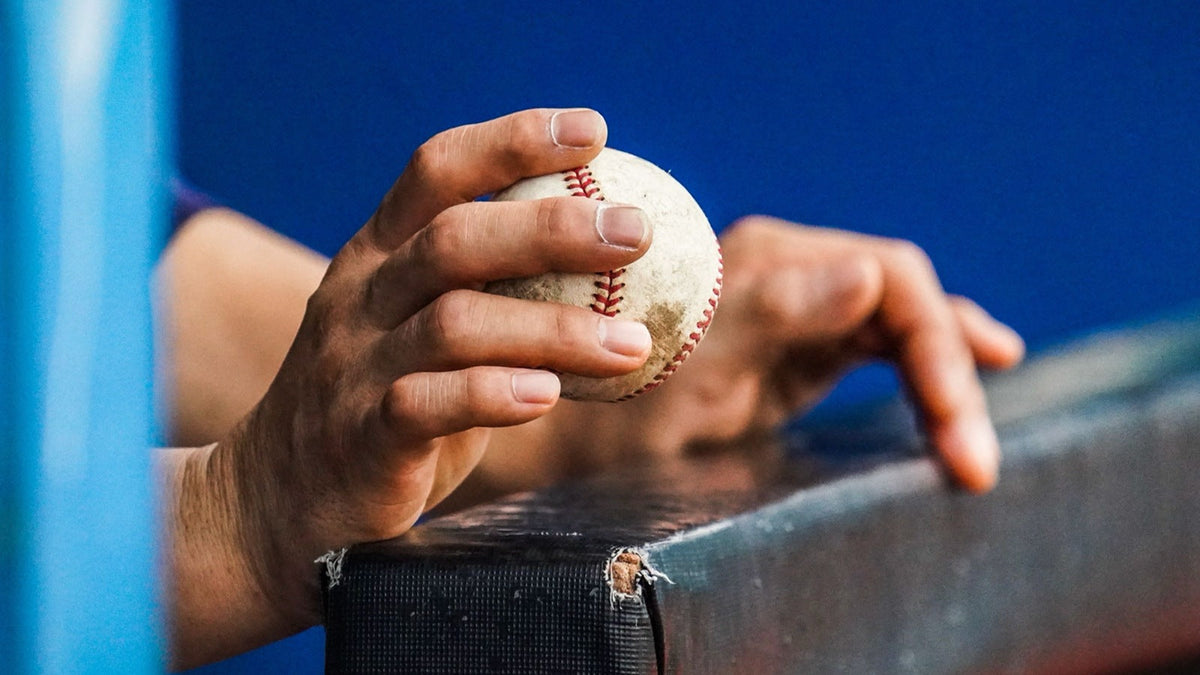
Your slider stops biting and your splitter feels mushy by the fifth inning, and the problem may live in your hand rather than your shoulder. Pitch grips are precision tools. The pressure of the middle finger on a curveball, how deep the ball sits on a splitter, the wrist angle at release on a two-seamer: these details are hard to hold steady when the forearm and finger muscles are tired. What looks on video like a mechanical flaw can be the grip fading first.
This guide is for pitchers who want to treat grip as something they can train. It covers both sides: grip as a performance tool for consistent release and pitch movement, and grip training done carefully so it supports the elbow instead of adding to its workload. For the wider picture across sports, start with the Grip Training for Sports hub.
This article is general training information, not medical advice. If you have elbow pain, numbness or tingling in the hand, or pain that lingers after throwing, see a sports medicine physician or physical therapist before adding grip work.
Why Grip Matters in Pitching
Every pitch starts with how you hold the ball. Finger pressure affects how the seams grip the air, ball position affects the spin axis, and wrist angle at release affects the plane of movement. All three get harder to repeat when the hand tires.
A four-seam fastball usually spreads pressure evenly across the index and middle fingers for clean backspin. A two-seamer tends to lean more on the index finger. A curveball relies on the middle finger pulling down at release with a relaxed index finger. A splitter sits deep between spread fingers and depends on control of that spread, not brute squeeze.
When the finger flexors fatigue, many pitchers drift toward one generic grip, with the same tension in every finger, and the differences between pitches start to blur. Pitchers often call it losing command late in the outing. Part of the fix is mechanics and workload; part of it is a hand that can hold its pattern longer.
That is why plain squeeze strength does not solve the whole problem. The small muscles inside the hand, the lumbricals and interossei, help control finger independence and spread. Forearm curls and heavy grippers do little for them; they respond to exercises that move the fingers one at a time. The Grip Training Encyclopedia covers the anatomy in more detail.
Pitch by Pitch: What Grip Does and What Fatigue Changes
These are general starting points. Hand size, arm slot and grip style vary, so treat this as a guide to what to watch for, not a rulebook.
| Pitch | Typical grip | Finger pressure | What often changes when the hand tires |
|---|---|---|---|
| Four-seam fastball | Index and middle fingers across the seams, thumb underneath | Even across both fingers; firm, not white-knuckled; ball on the finger pads, not in the palm | The ball sinks into the palm, backspin drops and the pitch flattens |
| Two-seam fastball | Fingers along the narrow seams | More on the index finger, which helps drive run | Pressure evens out and the pitch straightens |
| Slider | Fingers offset toward the outer part of the ball | Middle finger drives spin; index finger guides | The index finger takes over and the pitch loses tilt and late break |
| Curveball | Middle finger on the seam, index finger resting beside it | Middle finger dominant; index finger passive | The index finger tightens, the pull-down weakens and the pitch hangs |
| Splitter | Index and middle fingers spread outside the seams, ball deep | Low overall squeeze; control of the spread matters most | The fingers creep together, the ball sits shallower and the pitch loses its drop |
What Pitchers Should Train (and What They Should Not)
The common mistake is training grip like a powerlifter. A powerlifter needs maximum squeeze and long heavy holds. A pitcher needs finger independence, endurance in the small hand muscles, and the ability to repeat a pressure pattern over a full outing. Priorities:
- Small hand muscles: work that moves fingers one at a time, not only whole-hand closing.
- Finger independence: extending and flexing individual fingers against light resistance.
- Endurance over peak strength: holding a consistent pattern through a full outing, not one maximal squeeze.
- Extensor balance: finger and wrist extensor work to balance the heavy flexor load that throwing creates.
Key Exercises
- Band finger extensions, one finger at a time. Loop a light band around the fingertips and open one finger at a time against it. Low load, high reps. The IronMind Expand-Your-Hand Bands come in a pack of ten, so you can double them up or use them singly. The GripSaver Plus trains both opening and closing in one tool.
- Rice bucket work. Push the hand into a bucket of dry rice and cycle through gripping, opening, and wrist turns. Low load and high repetition, which suits a pitcher's needs.
- Forearm rotation with a light dumbbell. Slow palm-up to palm-down rotations with a 2 to 5 lb dumbbell or a hammer held near the head.
- Towel pinch holds. Pinch a folded towel between thumb and fingers and hold. Builds thumb and finger pad endurance.
- Wrist curls and reverse wrist curls. Light (often 5 to 15 lb), full range, controlled. Heavier is not better here.
- Light gripper work, sparingly. A light gripper has a place as a supplement. The Heavy Grips Fitness Series starts at 50 lb, well below the usual strength grippers.
Extensor and rehab tools are in the rehab and longevity collection, and forearm tools in the wrist trainers collection. For an overview of every tool type, see the Complete Guide to Grip Training Equipment.
6-Week Off-Season Grip Block
This block fits the window after a real rest period and before throwing builds back up. For many pitchers that is roughly mid-November through December. Do not start it the week the season ends: give the throwing arm a few weeks of genuine rest first, and follow your team's or physical therapist's throwing plan. Effort uses a simple 1 to 10 scale for the hand and forearm only, where 10 is all-out.
| Week | Day 1 | Day 2 | Effort |
|---|---|---|---|
| 1 | Band finger extensions 3x15 per hand; rice bucket 2x60 sec; wrist curls and reverse wrist curls 2x15 | Forearm rotation 3x12; towel pinch holds 3x20 sec; band full-hand opens 2x20 | 5 to 6 |
| 2 | Band finger extensions 3x20; rice bucket 3x60 sec; wrist curls and reverse 3x12 | Forearm rotation 3x15; towel pinch holds 3x25 sec; baseball fingertip holds 2x30 sec | 6 |
| 3 | Band finger extensions 4x20; rice bucket 3x75 sec; wrist curls and reverse 3x15; light gripper 2x10 | Forearm rotation 4x15; towel pinch holds 3x30 sec; light dumbbell carry 3x30 sec | 6 to 7 |
| 4 | Band finger extensions 4x20; rice bucket 3x90 sec; wrist curls 3x15; reverse wrist curls 3x15; light gripper 3x10 | Forearm rotation 4x15; towel pinch holds 4x30 sec; towel or rope hang 3x20 sec | 7 |
| 5 | Band finger extensions 4x25; rice bucket 4x90 sec; wrist curls 3x15; reverse wrist curls 3x15; light gripper 3x12 | Forearm rotation 4x20; towel pinch holds 4x35 sec; towel or rope hang 3x30 sec | 7 |
| 6 (deload) | Band finger extensions 2x15; rice bucket 2x60 sec; wrist curls and reverse 2x12 | Forearm rotation 2x12; towel pinch holds 2x20 sec; band full-hand opens 2x20 | 5 |
Keep the week 6 deload. It clears the extra fatigue from weeks 4 and 5 so you start throwing again with fresh hands and forearms. For a hang station at home, the Monkee Grip Rope Grips or a folded towel over a pull-up bar both work.
In-Season Maintenance
Once the season starts, you are maintaining grip, not building it. Throwing already loads the forearm heavily, and hard grip work on top of it tends to leave the forearm tight.
- Frequency: one short session a week on a light day, never the day before a start or a heavy bullpen.
- Volume: about 6 to 8 sets, roughly half the off-season volume.
- Effort: 5 to 6 out of 10. You should feel you could easily do more.
- Focus: extensor and small-muscle work: band opens, single-finger extensions, light forearm rotation. No heavy gripper work.
If an exercise leaves your forearm sore the next day, drop it. In season, throwing recovery comes first.
Protecting the Elbow
The ulnar collateral ligament (UCL) on the inside of the throwing elbow takes a large share of the stress when the arm accelerates. Grip training will not prevent UCL injuries on its own; workload, mechanics and rest matter most. Done sensibly, it supports the muscles around the elbow. Done carelessly, it adds fatigue to an arm that already has plenty.
Do Not Train Only the Flexors
Many of the forearm flexors start near the inside of the elbow. Pitchers who only squeeze build lopsided forearms. Finish every grip session with a few sets of band finger opens and reverse wrist curls. It feels easy. Do it anyway.
Endurance Over Peak Strength
The goal is not the highest squeeze test. It is holding the same pressure and finger position late in the outing. Higher reps, longer light holds and moderate rest match the job better than heavy singles. Train for the 90th pitch, not the grip test.
Weighted Balls Are Not Grip Training
Weighted ball programs are velocity tools. Using them to work the forearm misses the point and adds stress to a tired arm. If you run a weighted ball program, keep it on separate days from grip work and follow the program's own progressions. The grip strength in injury prevention and rehabilitation article covers the broader picture.
Frequently Asked Questions
What is the best exercise for a splitter grip?
Band finger extensions, one finger at a time, for 15 to 20 reps. They train the muscles that hold the finger spread when the hand is tired. Add towel pinch holds and rice bucket work for endurance. Heavy grippers are not the answer: a splitter spreads the fingers, which is close to the opposite of closing a gripper.
Should I train grip during the season?
Yes, lightly: one maintenance session a week on a light day, effort 5 to 6, focused on extensor and small-muscle work. When in doubt, do less. Two light sets beat skipping, and skipping beats training hard the day before a start.
I have deep pain in my fingers or palm after long outings. What should I do?
Surface soreness in the skin or finger pads usually settles with rest. Deep pain at the base of a finger, in the palm or into the wrist should not be trained through. Back off the pitch that causes it, keep the extensor work light, and see a sports medicine physician if it does not clear within about a week.
Is grip training appropriate for youth pitchers?
Keep it very light and simple: rice bucket work, light band extensions and forearm rotation with a 1 to 3 lb weight. Skip heavy grippers and heavy holds, and stop anything that leaves the forearm sore. A young pitcher's elbow is still developing, so pitch counts, rest and a coach's or physician's guidance come first; grip work stays a small extra.
Should I do grip work before or after throwing?
After, never before, and ideally on a different day from a heavy throwing session. Tired fingers make pitch grips less precise. In the off-season with no throwing, schedule grip work freely. Once bullpens start, put grip maintenance on a light day well away from your next big throwing day.
Do weighted balls improve grip strength?
No. They are for velocity. They do not target finger independence or the endurance that keeps pitch grips sharp, so keep them separate from grip training.
How much do regular grippers help pitchers?
Some, but less than most people expect. Closing a gripper is a symmetrical, whole-hand squeeze; pitching grips are uneven and finger-specific. Use a light gripper as a supplement. The band work, rice bucket and finger extensions in this guide carry over more directly.
Build the Grip Behind Your Best Pitches
Velocity gets the headlines, but command late in the game is partly grip endurance. The pitcher whose slider still moves in the seventh trained the hand and forearm for that job.
Run the six-week block before throwing ramps up, keep the extensor work in every session, take the deload, and switch to maintenance when the season starts. Bands, extensor trainers and light grippers are in the rehab and longevity collection and the wrist trainers collection. For other overhead and endurance sports, see Grip Strength for Calisthenics Athletes.
0 comments