


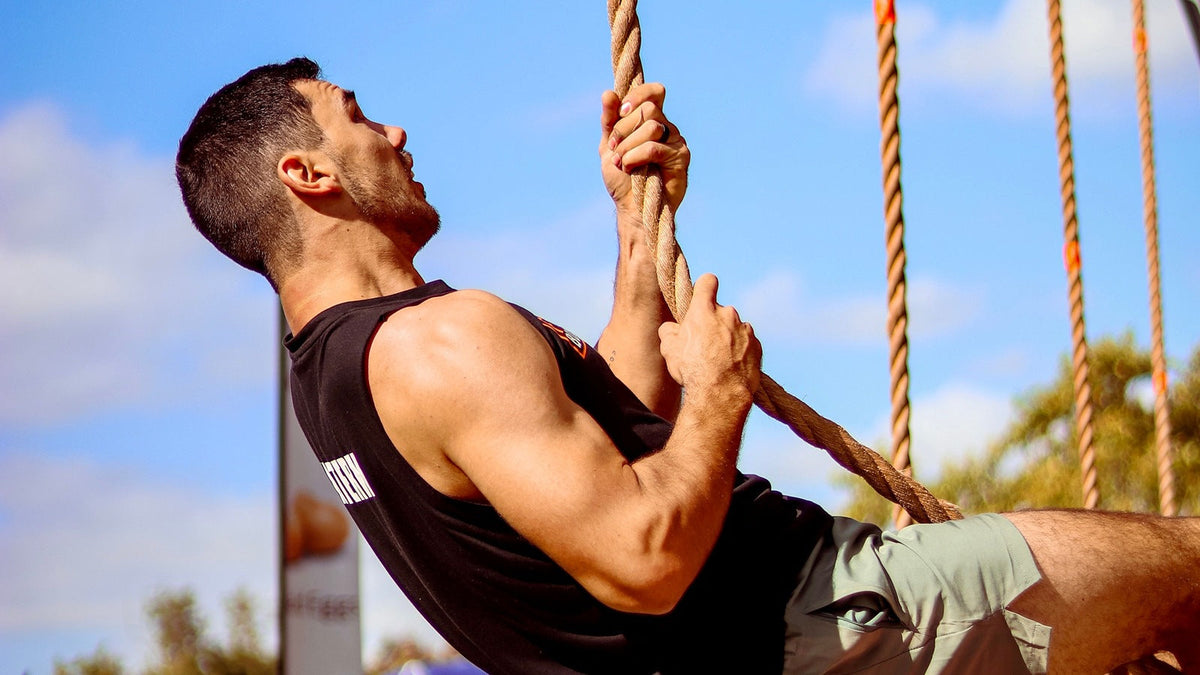
In obstacle course racing, a lot of races end at the rig, not on the trail. Your lungs are fine and your legs have miles left, but your forearms are pumped and your fingers are peeling off a wet bar. Many racers spend months on running and almost no time on the thing that most often stops them: grip.
This guide is for racers training for a specific event: Tough Mudder, Spartan or Hyrox. Each one asks something different of your hands, so generic forearm work only gets you part of the way. Below we break down each format, then give you an 8-week block to close the gap before race day. For the wider picture across sports, see the Grip Training for Sports hub.
Why OCR Is So Hard on Grip
Three things make OCR grip tougher than a gym session:
- You arrive tired. By the time you reach a rig you have run, carried and crawled. Your forearms have been working long before you touch the first bar.
- Wet and muddy hands. Chalk is little help once you have been through water or mud. On a wet bar, only real grip strength and endurance keep you on, and squeezing harder to make up for lost friction tires you faster.
- Long, linked obstacles. Many rigs ask for continuous hanging and swinging with a fresh re-grip at every handle. If you have only ever trained short dead hangs, a long traverse is a different job.
The fix is to train for the demands of your race. The table makes that concrete.
What Each Race Asks of Your Grip
Obstacle line-ups change from season to season and course to course, so check your event's obstacle list. These are the patterns that tend to hold.
| Race | Typical grip obstacles | Wet hands? | How grip usually fails | Train for |
|---|---|---|---|---|
| Tough Mudder | Monkey bar and ring traverses, often over water | Often | Forearm pump on long swinging traverses; hands give out mid-rig | Hang endurance and re-gripping while tired |
| Spartan Race | Multi-rigs, monkey bars, rope climb, heavy hoists and carries | Depends on the course | Too many grip types in one race; one weak pattern is enough to fail an obstacle | Variety: hangs, rope work, heavy carries, odd-object holds |
| Hyrox | Farmer's carry, sled pull, sled push, wall balls | No (indoor) | Grip fades on the farmer's carry before the legs do | Loaded carry endurance under running fatigue |
Tough Mudder
Tough Mudder leans on wet, swinging obstacles. Its signature rigs are typically long traverses of bars, rings or other handles, often over water, so you start the rig with damp hands and every handle is a new catch.
Monkey Bars and Multi-Section Traverses
The challenge is the re-grip. Each new handle needs a fresh, confident catch, and as the hands tire that catch gets slower and less secure. Training for these obstacles means practicing transitions while your forearms are already burning, not only static hangs. The pull-up grip guide covers the hang and pull work that builds the base.
Rings
Rings swing and rotate as you load them, so your wrist and forearm work harder to steady them than on a fixed bar. Include ring hangs and ring traverses in your training. The instability is the training effect, not a problem to avoid.
Spartan Race
Spartan courses mix overhead rig work and heavy carries in the same race. The grip problem is variety: different patterns, back to back, and one weak link is enough to fail an obstacle.
Multi-Rigs and Monkey Bars
Multi-rigs combine rings, ropes, bars and odd handles in one traverse. Rings need squeeze plus rotation control, ropes need a thicker, different hand position, and bars reward a solid hook of the fingers. Racers who only train one grip type struggle on the transitions. Rock climbing grip work is a close match for this; see the rock climbing grip exercises article.
Rope Climb
A thick rope loads more of the hand than a bar, and even with a good foot lock your hands hold you for every pull. Rope work builds strength and endurance in exactly the muscles that fail on rigs, so it carries over well to the rest of the course.
Hoists and Heavy Carries
Pulling a weighted bag up on a rope is a strength test for the hands, not an endurance test. Carrying a heavy round stone or bag is different again: there are no handles, so you hold it with open hands and a hug. Heavy rope pulls, thick-handle work and odd-object carries in training make both feel familiar.
Hyrox
Hyrox has no swinging and no rigs. What it asks for is sustained grip under load while you are tired from the running between stations. It is indoors, with no mud or cold, so grip failure here is a straight training gap.
Farmer's Carry
The farmer's carry is two kettlebells for 200 meters, with the weight set by your division (check the current Hyrox standards for yours). It is a common place to lose time, and it is usually the hands that go first, not the legs. Train carries at your race weight and race distance, near the end of a hard session, so you practice holding on while tired. Our strongman grip events guide covers carry technique and turns.
Sled Pull and Sled Push
The sled pull is a hand-over-hand rope pull, so each pull asks for a hard grip, again and again. Train it with thick rope pulls or towel rows. The sled push needs steady hand and forearm tension on the poles but much less grip.
Wall Balls
One hundred catches and throws add up. Each rep is light, but the total adds to the race's grip load. Do not neglect it in training.
Racing With Wet Hands
Chalk helps on dry bars but does little once your hands have been through mud or water. The only thing that survives a wet obstacle is grip strength and endurance you built in training. Train some hangs and carries with damp hands so a wet rig is not a surprise on race day.
Gloves
Thin gloves can add friction on dry handles and protect your palms, but they reduce feel, slow your re-grips and get slippery when soaked. Many experienced racers run bare-handed. If you race in gloves, train in them, and build enough bare-hand strength that gloves are optional.
Hand Care
File calluses flat (not off) after training sessions, because raised calluses are what catch and tear. Moisturize daily in the weeks before the race, and let any tears heal before you go back to heavy bar work.
8-Week OCR Grip Block
This block assumes a general fitness base and two or three grip days a week alongside your running. If your mileage is high, keep the effort moderate. Effort uses a simple 1 to 10 scale, where 10 is all-out.
| Week | Day 1 | Day 2 | Day 3 | Effort | Focus |
|---|---|---|---|---|---|
| 1 | Dead hang 3x30 sec; farmer's carry 3x50 m, light | Monkey bar traverses 4 full lengths; rope pull 3x10 m | Pinch hold 3x20 sec; towel pull-up 3x5 | 6 | Baseline |
| 2 | Dead hang 3x35 sec; farmer's carry 3x60 m at race weight | Monkey bar traverses 5 lengths; rope climb 3 ascents | Pinch hold 3x25 sec; towel pull-up 3x6 | 6 to 7 | Carry endurance |
| 3 | Dead hang 4x35 sec; farmer's carry 4x60 m at race weight | Mixed-handle traverse 4 times; rope pull 3x15 m | Odd-object hold 3x15 sec; ring hang 3x20 sec | 7 | Variety |
| 4 | Dead hang 4x40 sec; farmer's carry 4x80 m at race weight | Run 400 m hard, then monkey bars, 4 rounds; rope climb 4 ascents | Pinch hold 4x25 sec; ring traverse 3 lengths | 7 to 8 | Grip while tired |
| 5 | Dead hang 4x45 sec; farmer's carry 3x100 m at race weight | Mixed-handle traverse 5 times; rope pull 3x20 m | Towel pull-up 4x6; odd-object hold 3x20 sec | 7 to 8 | Peak volume |
| 6 | Dead hang 3x45 sec; farmer's carry 3x100 m at race weight | Run 400 m hard, then monkey bars, 4 rounds; rope climb 3 ascents | Ring hang 4x25 sec; sandbag carry 3x50 m | 8 | Race simulation |
| 7 | Dead hang 3x35 sec; farmer's carry 3x60 m | Monkey bar traverses 3 lengths; rope pull 2x15 m | Pinch hold 3x20 sec; ring hang 2x20 sec | 6 | Deload, about 30% less volume |
| 8 (race week) | Dead hang 2x30 sec; farmer's carry 2x40 m, light | Two easy traverses; rope pull 1x10 m | Rest or light mobility | 4 to 5 | Taper |
Equipment for the Block
- Hangs: a pull-up bar works. For open-hand and edge hangs that carry over to rigs, a hangboard such as the Wood Grips Prime Rib Hangboard or the Metolius Climber's Edge Board; more in the hangboards collection.
- Rope and towel work: Monkee Grip Rope Grips hang from a pull-up bar and stand in for rope sections and towel pull-ups.
- Thick handles for carries and hoists: Fat Gripz on dumbbells or kettlebells make every carry harder on the hands.
- Pinch holds: two plates smooth side out, or Country Crush Pinch Blocks on a loading pin.
- Balance the hand: a few sets of band finger opens with the IronMind Expand-Your-Hand Bands at the end of each grip day.
Everything else is in the grip tools collection and the Complete Guide to Grip Training Equipment. For endurance-focused grip programming in a similar sport, see Grip Strength for CrossFit Athletes, and for bar and ring work, Grip Strength for Calisthenics Athletes. The Grip Training Encyclopedia covers the principles behind the block.
Saving Grip on Race Day
Training builds the capacity; race day is about spending it well. Many grip failures in OCR are pacing failures: arriving at the first rig already pumped, or death-gripping the first obstacle and reaching the next one half spent.
Do Not Spend Grip Early
Every bit of unnecessary tension comes out of the reserve you need at the rig: clenched fists while running, over-gripping easy obstacles, bracing too hard through crawls. Run with loose hands. The racers who clear every rig are not always the strongest; they arrive at each one with the most left.
Share the Load Between Hands
On traverses, let each hand take turns doing the most work. On swinging obstacles, the trailing hand is lightly loaded for a moment on each swing; use that moment to relax it before the next catch.
Recover Between Obstacles
Shake out your forearms and open your hands on the jog between obstacles. If a rig has a place to pause, hang on straight arms for a few seconds so the skeleton takes more of the load.
FAQ
What is the single best way to train grip for OCR?
Monkey bar traverses while tired. Run 400 meters hard, then go straight into a full traverse. It matches what you face on course: out of breath, with forearms already working.
Should I use gloves for OCR?
Only if you have trained in them. Thin gloves can help on dry rigs but get slippery when soaked, and many experienced racers go bare-handed. Calluses filed flat protect your palms more reliably in wet conditions.
How should I prepare for my first OCR?
Start with dead hangs: three sets as long as you can hold, three days a week, for six weeks. A 45-second hang is a solid working base for many beginner rigs. Add farmer's carries for distance. Those two cover most first-race grip demands. The pull-up grip guide covers the foundation work.
Should I focus on grip endurance or peak grip strength?
Endurance, by a wide margin. Most racers who fail rigs have enough strength for one hang; they run out of endurance at the wrong moment. Peak strength matters more for heavy hoists and carries, but once you have a reasonable base, endurance pays off more.
How often should I train monkey bars?
Two or three times a week at moderate effort. Finger tendons adapt more slowly than muscle, and daily hard sessions invite irritation rather than progress. Progress by adding lengths or sets, not more days.
How do I look after my hands between races?
File calluses flat after training and moisturize daily. After a race, let any tears heal before you go back to heavy bar work; a few days off is usually enough for the skin and costs you very little strength.
What does a race-week taper look like for grip?
Cut grip volume by about half in the final week. One light session early in race week keeps you sharp without adding fatigue: a short carry and a couple of easy traverses, nothing maximal. Skip grip training in the last two days before the race.
0 comments