


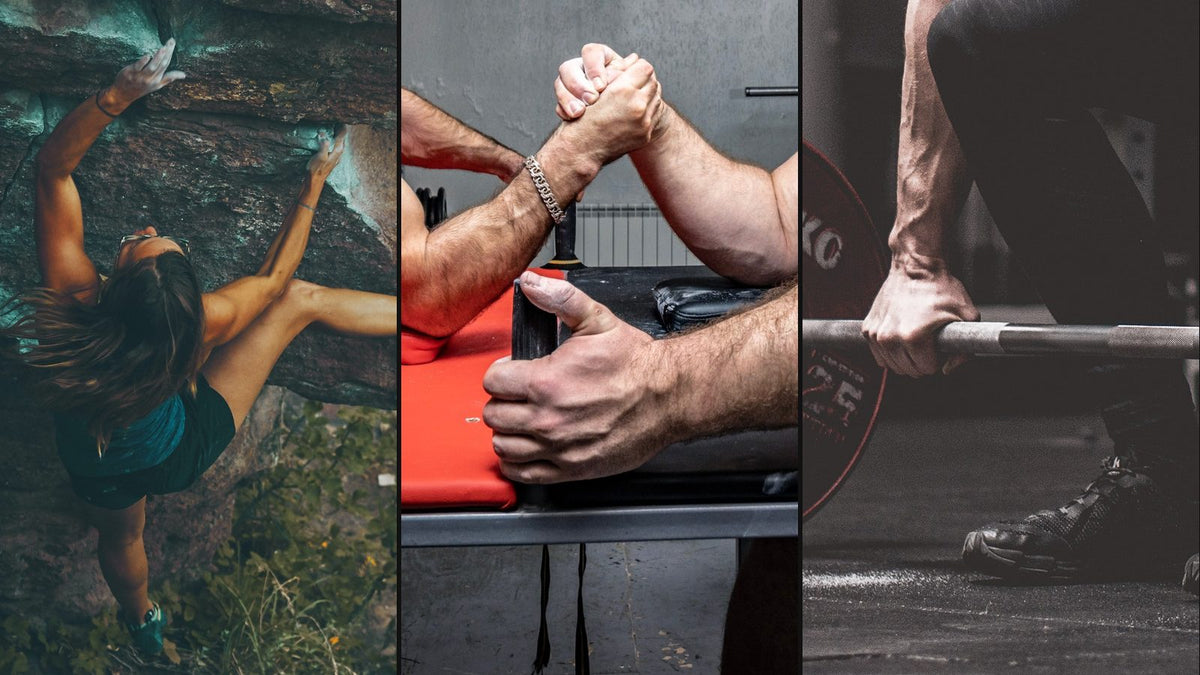
Generic forearm work is a starting point, not a training plan. Every sport places a different demand on your hands. A climber needs open-hand finger endurance on small holds; an arm wrestler needs cupping depth and anti-rotation under near-maximal load; a powerlifter needs a supporting grip that does not give out before the legs do. Training the wrong pattern, even hard, does not transfer. This guide maps what your sport actually requires and how to train for it.
It is written for competitive and recreational athletes who are tired of grip being the weak link in their sport. It covers 15 sports, a full demand map, in-depth programming notes for six sport groups, and a framework for building a sport-specific grip program that fits around your existing training. If you want a complete training system from the ground up, the Grip Training Encyclopedia is the foundational resource. For the equipment side, The Complete Guide to Grip Training Equipment covers every tool by grip type.
Why Sport-Specific Grip Training Matters
Most athletes who start training grip pick up a hand gripper because grippers are affordable, simple and easy to track. That is not a bad start: crushing grip is real and trainable. But for most sports, a strong gripper close is one piece of a larger puzzle. The grip demands of climbing look almost nothing like the grip demands of powerlifting, which look almost nothing like what a BJJ athlete needs through a long round. Training without that clarity is how you end up with a powerful crush and still lose your grip in competition.
The principle is specificity, the same one that governs the rest of strength training: you get better at the pattern you train. If your sport demands open-hand endurance and your training only covers crushing, you are building a quality next to the one you need, not the one itself. Sport-specific grip work closes that gap. It also builds resilience in the tissues your sport loads most, since grip-related overuse problems tend to show up when load piles up in patterns an athlete has never trained directly.
For a baseline on where your grip sits right now, see grip strength standards, which gives you reference numbers before you start building.
The 5 Grip Patterns Every Sport Uses
Before mapping sports to training, it helps to have the five core grip patterns clear. Every grip demand in every sport is a combination of one or more of them. Once you know which patterns your sport emphasizes, the programming decisions become much easier.
Crush (Closing Strength)
Crush grip is the force generated when the fingers close toward the palm against resistance. It is the pattern of handshakes, hand grippers and barbell holds. The primary movers are the long finger flexors (flexor digitorum superficialis and profundus) running through the forearm. Crush is the most commonly trained grip pattern, and often over-trained relative to the others. Sports where crushing grip matters most: arm wrestling, powerlifting (holding the bar), strongman, MMA, and bat and racket sports that need fast closing force. Training tools: thick bar deadlifts, loading pin holds, and two fixed hand grippers, a working gripper and a goal gripper. The Captains of Crush progression ladder is the classic benchmark, and the Heavy Grips 2-packs, 3-packs and 6-pack give you a full ladder of resistance levels to progress through.
Pinch (Thumb Opposition)
Pinch grip is the force produced by the thumb opposing the fingers, with little palm involvement. It draws on the thenar muscles at the base of the thumb, a different primary mover from crush. This is why experienced gripper users often find they cannot hold a smooth plate pinched between thumb and fingers for more than a few seconds: crush work does not train the muscles that pinching demands. Sports where pinching is primary or significant: grip sport (hub lifts, pinch events), armlifting, BJJ and wrestling (wrist and collar control), and climbing (pinch holds). Training tools: plate pinches, pinch blocks, the IronMind Hub, and the rest of the grip tools collection.
Support (Holding Under Load)
Support grip is isometric endurance: the ability to hold on under sustained load without the fingers unwinding. It is a different quality from peak crush force. You can have a strong crush and poor support, and the reverse. The quality that limits deadlifts, farmer carries and long climbing routes before the legs or back give out is almost always supporting grip endurance. Sports where support grip is critical: strongman (farmer walk, loading events), powerlifting (heavy deadlift sets), Olympic weightlifting, rowing and rock climbing (route endurance). Training tools: timed barbell holds, dead hangs, farmer carry handles and loading pins.
Open-Hand (Finger Flexion at Extension)
Open-hand grip loads the fingers while they are partly or fully extended rather than curled into the palm. That changes which structures take the load: the A2 and A4 flexor tendon pulleys see much more stress, and the small muscles inside the hand contribute more than they do during crushing. Open-hand strength is the grip of climbing holds; crimps, slopers and pockets all require it. Thick bar and axle lifting demand it too, because the larger diameter forces a more open finger position. Standard gripper work largely ignores this pattern. Sports where open-hand grip decides results: rock climbing first, then any thick-bar or odd-implement lifting event. Training tools: hangboards, thick grips such as Fat Gripz, and the hangboards and climbing gear collection.
Anti-Rotation (Resisting Twist Under Load)
Anti-rotation grip is the ability to resist a force trying to twist the wrist, hand or implement out of position. It differs from the other four patterns because it is reactive: you are resisting force, not producing it. The wrist flexors, extensors and the forearm rotators all contribute, depending on the direction and size of the twist. Sports where anti-rotation is a primary demand: arm wrestling (resisting pronation and supination throughout a match), tennis and golf (resisting racket and clubhead twist through impact), grappling (holding position while an opponent strips or rotates your grip), and any implement with rolling or rotational forces. Training tools: a rolling handle such as the Country Crush Raptor, a wrist roller such as the Wrist Wrench, the wrist and forearm trainers collection, reverse curls and Zottman curls.
Grip Demand Map by Sport
The table below maps 15 sports and fitness contexts to their primary grip patterns, the balance of endurance and power, and the most useful training equipment. Use it as a triage tool: find your sport, see where your training falls short, and use the sport-by-sport sections below to fill the gaps.
| Sport | Primary Pattern | Secondary Pattern | Endurance vs Power | Key Equipment |
|---|---|---|---|---|
| Climbing | Open-hand | Support | Endurance-dominant | Hangboard, thick grips |
| Arm Wrestling | Crush + Anti-rotation | Pinch | Power with short endurance bursts | Rolling handle, wrist trainer, arm wrestling handles |
| Powerlifting | Support | Crush | Endurance under max load | Loading pin, thick bar, chalk |
| Strongman | Support | Crush + Open-hand | Mixed: power for picks, endurance for carries | Farmer handles, loading pin, axle bar |
| Brazilian Jiu-Jitsu | Crush | Support + Anti-rotation | Endurance-dominant (5 to 10 min rounds) | Gi grip drills, loading pin, thick rope |
| Wrestling | Crush + Pinch | Anti-rotation | Mixed intensity bursts | Wrist roller, thick rope, towel pull-ups |
| MMA | Crush | Support + Anti-rotation | Intermittent power | Hand grippers, rope work, loading pin |
| Tennis | Anti-rotation | Crush | Power at impact, light endurance | Wrist trainers, wrist roller |
| Golf | Anti-rotation | Support | Endurance over 18 holes | Wrist trainers, light grippers, forearm work |
| Baseball | Anti-rotation | Crush | Explosive power at contact | Wrist roller, hand grippers |
| Football (Linemen) | Crush | Anti-rotation | Power with short holds | Hand grippers, thick bar, wrist roller |
| Football (RBs/WRs) | Open-hand | Crush | Short and explosive | Light pinch work, grippers, ball security drills |
| Hockey | Crush | Anti-rotation | Endurance over a shift | Grippers, wrist roller, forearm work |
| Rowing | Support | Crush | Endurance-dominant | Loading pin, thick grips, pull-up bar |
| Olympic Weightlifting | Support | Open-hand | Power with a brief hold | Hook grip practice, chalk, loading pin |
| CrossFit / General Fitness | Support + Crush | Open-hand | Mixed, changes workout to workout | Kettlebells, barbell, pull-up bar, loading pin |
Sport-by-Sport Programming Notes
The sections below cover six sport groups in depth. Each explains the grip demand specific to that sport, the most effective ways to train it, a sample frequency, and links to deeper resources. These are starting points, not templates to follow blindly. Adjust volume and frequency to how much grip work your sport practice already gives you.
Climbing
Climbing is the most demanding grip sport for connective tissue. The primary demand is open-hand strength, the ability to produce force with the fingers partly extended on small holds, and the secondary demand is supporting endurance to hold that position through a long route. What makes climbing unique is that the structures taking the load are not mainly the finger flexor muscles. They are the flexor tendon pulleys (especially A2 and A4) and the connective tissue of the fingers. These tissues adapt far more slowly than muscle, which is why jumping into high-volume hang work without tendon preparation leads to pulley injuries.
The cornerstone of climbing-specific grip training is the hangboard. Half-crimp and open-hand positions on progressively smaller edges build the exact pattern climbing demands. A common beginner protocol: 7-second hangs on a 20 mm edge at a moderate effort, 6 sets, 3 minutes' rest between sets, twice per week. Err lighter than you think for the first 6 weeks; the tendons need time to adapt however strong your arms feel. The full crimp (thumb locked over the index finger) puts the most strain on the pulleys and should be used sparingly, if at all, by newer climbers. Extensor work is non-negotiable: finger extensions after every climbing session protect the tendons that constant pulling loads. Our guide to the best grip strength exercises for rock climbing goes deeper.
Frequency: 2x/week dedicated hang work, on separate days from hard climbing. In season: 1x/week maintenance only.
Key equipment: hangboards, the rock climbing collection, and extensor bands such as the IronMind Expand-Your-Hand Bands.
Common gap: Most climbers train open-hand and support but neglect pinch and crush. A monthly plate pinch session reveals this weakness fast.
Arm Wrestling
Arm wrestling has the most technically specific grip demand of any sport, and the most common mistake arm wrestlers make is training generic crush strength and calling it grip work. The patterns that win matches are cupping (flexing the wrist toward you to bring the opponent's hand down and in), pronation (rotating the forearm inward against resistance), back pressure (driving the back of the hand away), and anti-rotation (stopping the opponent from stripping your position). Supporting endurance underpins all of them, since a match can mean many seconds of near-maximal isometric effort.
The most effective tools for arm wrestling grip are a rolling handle, which trains anti-rotation under load, and wrist trainers that load wrist flexion on its own. Plate pinches and pinch blocks build the thumb strength that helps you hold a cup. Hand gripper work builds a general foundation but should not take over your grip training time; the sport-specific patterns need targeted attention. The arm wrestling grip training program covers a full 12-week, 3-phase plan built around these patterns, and arm wrestling handle training explains how to use handles at the table angles that matter.
Frequency: Grip training 2 to 3x/week, at least 48 hours away from table practice. During competition prep, treat grip work as its own skill session, not accessory work tacked onto a strength day.
Key equipment: the arm wrestling handles and grips collection, the Country Crush Raptor rolling handle, the arm wrestling collection and wrist trainers.
Common gap: Training only pulling and cupping and neglecting back pressure and pronation. If you can win with a top roll but not a hook, or the reverse, the missing pattern is usually a grip and wrist deficit, not a strength deficit.
Powerlifting and Strongman
Powerlifting's grip demand is simple but important: supporting endurance under near-maximal load. A competition deadlift asks the fingers to stay closed for several seconds at loads nothing else in the gym replicates, and elite lifters pull well over three times bodyweight. When the grip fails at the top of a heavy pull, it is usually not a strength failure. It is a supporting endurance failure, and it is trainable.
The most direct transfer exercise is a timed barbell hold at competition percentages. Holding 80 to 90% of your deadlift max for 10 to 20 second sets, two or three times per week, trains the supporting grip in the exact position the sport demands. The hook grip (thumb trapped under the first fingers, as in Olympic weightlifting) is worth developing for heavy singles. Thick bar work, with Fat Gripz or an axle, builds open-hand strength as a secondary benefit and gives you a buffer of general grip strength under the competition-specific work. Straps remain useful for volume work; the mistake is using them for everything and never training grip directly.
Strongman adds complexity. Farmer carries, yoke walks and odd implements like the Inch dumbbell demand not just supporting endurance but the ability to hold on while the body is moving and fatigued. Farmer handles allow loading beyond what dumbbells permit, and carry distance is a good way to track supporting grip endurance. For background on which implements have proven their value over the decades, see From Iron to Innovation: Modern Grip Tools.
Frequency: 2x/week timed holds or thick bar work, on pulling days or as a separate 15-minute session after training. Heavy grip work the day before a competition deadlift is counterproductive; allow 48 hours or more.
Key equipment: loading pins, Fat Gripz, farmer carry handles and chalk. See the lifting and general strength collection.
Common gap: Powerlifters often have a solid crush but weak supporting endurance at high percentages. Test it: hold 80% of your deadlift max double overhand for 30 seconds. If you can't, there's your answer.
Brazilian Jiu-Jitsu and Wrestling
Grappling sports are the most grip-demanding endurance sports outside climbing. A 5-minute BJJ round, especially in the gi, means continuous gripping, grip breaking, re-gripping and resisting grip breaks against an opponent who is trying to strip your hands. The demands are crushing strength (to establish grips), supporting endurance (to keep them through the round) and anti-rotation (to resist strips). Pinch grip shows up in wrist control and some collar grips. Finger independence, keeping one finger's hold while others are attacked, is a real skill that dedicated grip training develops.
The most specific BJJ grip exercise off the mat is the towel or rope pull-up, which mimics the textured, slightly unstable feel of a lapel or sleeve and builds the crushing endurance the sport demands. Gi-specific work, gripping a gi jacket or sleeve anchored to a bar or doorframe for timed pulls and holds, is a low-cost, high-transfer option. For a strength foundation, hand grippers and loading pin holds build the base. Periodization matters: heavier grip work in the off-season, less volume in competition prep, maintenance in season. Our guide to improving grip strength for BJJ goes deeper.
For wrestling, the emphasis shifts toward dynamic grip work: establishing and breaking positions rather than long holds. Wrist roller work matches the rotational demands of hand fighting, and thick rope work builds the feel of collar ties. Both sports share a critical need for extensor balance: after every heavy gripping session, finger extensions protect the tendons that constant pulling loads. For periodization principles that apply directly to grappling grip work, see the periodized grip training guide.
Frequency: 2 to 3x/week off-mat grip work in the off-season, 1 to 2x/week in competition prep. Mat work itself is a big grip stimulus, so account for it before adding more.
Key equipment: thick rope, a gi or towel for pull-ups, hand grippers, a loading pin and extensor bands such as the IronMind Expand-Your-Hand Bands.
Common gap: Training grip as a strength-only quality when the sport demands endurance. A grappler who can close a Captains of Crush No. 2 but whose hands open up in the third minute of a hard round needs more endurance work, not more max strength.
Tennis, Golf and Baseball
Racket and bat sports sit in a different corner of the demand map. The primary pattern is anti-rotation: resisting the twist that a racket face, clubhead or bat produces through the swing and at contact. In tennis, the wrist has to stabilize against a ball impact that tries to twist the racket. In golf, a consistent clubface through impact is largely a forearm and wrist stability problem. In baseball, bat speed is the main athletic demand, but keeping a firm grip and wrist through contact stops the bat from turning in the hands.
None of these sports needs high crushing force. What they need is wrist stability: the ability to co-contract the wrist flexors and extensors into a stiff, controlled platform through impact. Train it with wrist roller work in both directions, reverse curls and Zottman curls. Band-resisted wrist deviations, moving the wrist toward the thumb side and the little-finger side against resistance, are overlooked in most programs but relevant to racket face control. Keep loads light to moderate; these are stability and endurance qualities. Two sessions per week of 3 sets of 15 to 20 reps is usually enough to maintain and improve in season.
Baseball players should note that training for hitting and training for pitching differ. The throwing arm needs careful load management and controlled wrist work, not heavy gripper sessions. For the broader case for grip work, see the benefits of grip strength.
Frequency: 2x/week year-round, dropping to 1x/week in heavy competition blocks. Sessions before practice work well, because light stability work warms the hands up rather than tiring them.
Key equipment: the wrist and forearm trainers collection, a wrist roller such as the Wrist Wrench, light resistance bands and light grippers.
Common gap: Many racket and bat athletes who develop tennis elbow or golfer's elbow have never done dedicated wrist extensor or flexor work. Building that strength takes far less time than recovering from an elbow problem.
CrossFit and General Fitness
CrossFit and general fitness present a different challenge: the grip demand is mixed and changes from workout to workout. One session is high-rep barbell cycling, where supporting grip and the hook grip matter most. The next is kettlebell swings and Turkish get-ups, where wrist stability and rotational endurance come first. Gymnastics movements such as toes-to-bar, muscle-ups and ring work need supporting and open-hand strength, and rope climbs add crush grip. No single pattern dominates, so the need is balanced development across all five.
The good news for CrossFit athletes is that the training itself gives a lot of grip stimulus. The problem is that it is unstructured and often piles up more volume than connective tissue can recover from. The most common grip problem in CrossFit is not weakness but overuse: torn hands from high-rep pull-ups, forearm pump that limits performance in workouts, and wrist pain from volume without recovery. A short dedicated grip session once or twice a week, focused on extensor work (often missing entirely from CrossFit programming) and specific weak patterns, does more than adding more pulling volume.
For a general grip foundation, What Is Grip Strength covers the main grip types and how they relate to training. For a budget-smart equipment path, see the grip tool starter path.
Frequency: 1 to 2x/week dedicated sessions. Prioritize extensor balance and whatever weak link your workouts reveal. Most CrossFit athletes need less crushing volume and more supporting endurance and extensor work.
Key equipment: two fixed hand grippers, a loading pin, a pull-up bar and an extensor trainer. The grip tools collection covers the core tools.
Common gap: Torn hands and forearm pump are signs that training volume has outpaced connective tissue recovery. The fix is not lighter weights; it is extensor balance, grip recovery and structured periodization instead of random daily accumulation. Pull-ups are a common limiter here, and our guide to pull-up grip strength covers them.
How to Build a Sport-Specific Grip Program
Three steps, every time, whatever the sport.
Step 1: Identify your primary grip pattern. Use the demand map above. Find your sport and note its primary and secondary patterns. If two sports apply (a CrossFit athlete who also competes in powerlifting, for example), list both and find the overlap. The overlap is where your training should concentrate; the gaps need targeted work.
Step 2: Match equipment to pattern. Each grip pattern has tools that train it most efficiently. Open-hand: hangboard and thick bar. Support: loading pin and timed holds. Crush: grippers and barbell holds. Anti-rotation: wrist roller and rolling handle. Pinch: plate pinches and pinch blocks. Train a pattern with the wrong tool and do not expect it to transfer. See the equipment guide for the full pattern-to-tool map and the grip tools collection for sourcing.
Step 3: Train 2 to 3x/week without colliding with sport practice. Grip training on the same day as your sport creates a conflict: tired hands perform worse in practice and pile up injury risk. The standard rule is at least 24 hours between a dedicated grip session and practice that demands full grip performance, and 48 hours is safer after heavy grip work. The off-season allows more grip training; in season, drop to 1 to 2x/week maintenance. The periodized grip training guide covers in-season and off-season programming in detail.
When to Train Grip Around Your Sport
Timing is where most athletes go wrong. Grip is not like leg training: your hands and forearms are involved in almost every athletic activity, so loading them affects everything else you do that day.
Frequency by sport: Grapplers (BJJ, wrestling, judo) already get a lot of grip work in their sport and should keep dedicated sessions to 1 to 2x/week in season, adding volume only in off-season blocks. Strength athletes (powerlifting, strongman) can run 2 to 3x/week because their sport practice does not pile up grip volume on the same days. Climbing is the exception: grip training is the sport, so recovery is decided by how the climbing itself is planned. Racket and bat athletes can run 2x/week year-round with little interference if loads stay moderate.
Same day or separate day: For sports with a high grip demand (grappling, climbing, arm wrestling), training grip on a sport day means one or the other suffers. Train grip on separate days, or do 10 to 15 minutes of maintenance work after practice as a finisher rather than before. In the gym the same rule applies: grip exercises go at the end of a session, not the start. A tired grip at the start of a deadlift session adds injury risk, not training stimulus.
In season vs off-season: The off-season is when you build. Volume and load can be higher because sport practice is lighter and recovery is better. In season you maintain and stay sharp: cut grip volume by 30 to 50%, keep the intensity, and focus on sport-specific patterns only. Peaking grip for a competition works like peaking any strength quality: reduce volume 7 to 14 days out, keep a little intensity, and arrive with fresh hands.
Equipment by Sport: Quick Reference
This table is for athletes who know their sport and want to know what to get. Must-have tools are the minimum effective setup; nice-to-have tools widen your options once the basics are covered.
| Sport | Must-Have Tool | Nice-to-Have Tool |
|---|---|---|
| Climbing | Hangboard | Extensor trainer, thick grip attachments |
| Arm Wrestling | Rolling handle (Country Crush Raptor) or wrist trainer | Arm wrestling handle set, pinch block |
| Powerlifting | Loading pin (for timed holds) | Fat Gripz or an axle bar, chalk |
| Strongman | Farmer carry handles | Loading pin, axle bar, thick implements |
| BJJ / Wrestling | Thick rope or a gi for pull-ups | Loading pin, hand grippers, extensor trainer |
| MMA | Hand grippers + thick rope | Loading pin, wrist roller |
| Tennis | Wrist trainer or wrist roller | Resistance bands, light grippers |
| Golf | Wrist trainer | Wrist roller, extensor trainer |
| Baseball | Wrist roller + hand grippers | Extensor trainer |
| Football (Linemen) | Hand grippers + thick bar work | Loading pin, wrist roller |
| Rowing | Loading pin for timed holds | Thick grip attachments, pull-up bar |
| Olympic Weightlifting | Hook grip practice + chalk | Loading pin for support work |
| CrossFit / General Fitness | Two fixed grippers + pull-up bar | Loading pin, extensor trainer, thick grips |
For the full equipment guide organized by grip type, see The Complete Guide to Grip Training Equipment. Chalk is in the chalk and accessories collection.
Common Cross-Sport Mistakes
- Training only the pattern that already feels strong. Athletes default to what they are good at. A powerlifter who spends all their grip time on timed holds and none on pinch or open-hand work is training the easy parts. The weak pattern is the one limiting performance, and it is the one you are least likely to train without a plan.
- Ignoring extensor work. Every sport on this list involves gripping, which means constant loading of the finger flexors. Without the extensors to balance that load, the tendons and pulleys take the stress unevenly. Finger extensions after every heavy grip session are not optional accessory work; they protect the connective tissue that makes gripping possible.
- Treating grip as accessory work, not a skill. Grip has technique: hand position, finger placement, wrist angle, thumb involvement. A few gripper reps between sets is an afterthought. Fifteen focused minutes of structured, progressive, sport-specific grip work beats thirty unfocused minutes tacked onto every session.
- Training grip the day before competition. This one costs athletes more than any other. Hard grip training leaves real muscular and connective tissue fatigue, so a session 12 to 18 hours before a competition means you show up with a weaker grip when it matters most. Leave at least 48 hours after any volume grip work, and 72 after anything heavy.
- No periodization. The tendons and pulleys that grip training loads recover on a much longer timeline than the muscles around them. Running the same volume and intensity all year, with no easy blocks or seasonal changes, is how overuse injuries develop. The periodized grip training guide covers this in full.
- Never testing. It is easy to feel your grip is "good enough" with no reference point. The grip strength standards give you benchmarks, and What Is Grip Strength covers the grip types so you know which one to test.
Frequently Asked Questions
Do I need to train grip if my sport already uses my hands a lot?
Usually yes. Sports with a lot of gripping (grappling, climbing, rowing) build grip as a byproduct, but they also pile up fatigue and create imbalances. A BJJ athlete who never trains grip on its own often has decent crush strength but a weak pinch, weak extensors and supporting endurance that fades late in rounds. Sport practice trains the patterns your sport emphasizes; dedicated training fills the gaps and builds the resilience that practice alone does not.
What is the best single exercise for athletic grip?
It depends on the sport. For strength and power athletes, timed holds on a loading pin. For athletes who hang or pull overhead, weighted dead hangs. For grapplers and combat athletes, towel or thick rope pull-ups. There is no universal best exercise because sports demand different patterns. What is universal: any grip exercise done consistently and progressively, aimed at the pattern your sport demands, produces sport-relevant results. The Grip Training Encyclopedia covers the full exercise library by pattern.
How is grip training for athletes different from bodybuilding forearm work?
Bodybuilding forearm training is about size, usually with wrist curls, reverse curls and wrist rollers for time under tension. Athletic grip training is about function: producing and holding force in the grip position your sport demands. The two overlap, but the goal changes the training. An arm wrestler does not need bigger forearms as such; they need stronger pronation and anti-rotation under load. A climber needs tendon and pulley resilience on open-hand holds, not forearm mass. Size tends to follow functional training anyway. Train the pattern first.
Will grip training help my sport even if I am already strong?
Very likely, because grip failure in trained athletes is rarely about maximum strength. It is usually about endurance, pattern specificity or the particular grip your sport demands. A strong powerlifter whose grip fails at 95% usually has plenty of crush force but not enough supporting endurance near max. A strong arm wrestler who keeps losing usually has one or two patterns well developed and one or two lagging. Finding and fixing that specific gap, rather than training more of what is already strong, is where grip work pays off for experienced athletes.
When should I peak my grip strength?
The same way you peak any strength quality: build in the off-season, maintain in season, peak for competition. For grip, allow 7 to 14 days of reduced volume before your most important event. Keep one or two short sessions in that window to stay sharp, but do not add new exercises or heavier loads. The tendons and pulleys recover more slowly than muscle, so build in more buffer than you think you need. The periodized grip training guide has a full framework, including how to structure a peak.
Can grip training cause overuse in sports that already stress the hands?
Yes, if it is done wrong. Adding high-volume crush work on top of many hours of climbing a week is a recipe for pulley injuries. The safest approach when your sport already gives you a lot of grip work: find the patterns your sport does not train well and use dedicated sessions for those, rather than piling more volume onto patterns that are already loaded. Keep total volume (sport plus dedicated training) within what your connective tissue can recover from, and always include extensor work.
Your Next Step
Grip is the connection between your training and your sport. Knowing your sport's demand is the first step; building it systematically is the next. Start with the demand map, find your primary pattern, and match your equipment to it.
- Arm wrestlers: start with the 12-week arm wrestling grip program and the arm wrestling collection.
- Climbers: see the best grip exercises for rock climbing and the hangboards and climbing gear collection.
- Powerlifters and strongman athletes: see the lifting and general strength collection and the full equipment guide.
- Grapplers and combat athletes: see grip strength for BJJ, the grip tools collection and the periodized grip training guide.
- Racket and bat athletes: start with the wrist and forearm trainers collection and What Is Grip Strength.
- Grip sport and armlifting: see the grip sport and armlifting collection and Robert Spindler's guest essay on getting involved in grip strength competitions.
- Everyone: the Grip Training Encyclopedia covers every grip type, every pattern and a full progression system in one place.
0 comments